

Drive through Fredericksburg in July, and you can read the lawns like a report card. Some are thick and green, and others are thin, patchy, and full of crabgrass.
The difference is rarely luck. It comes down to the right grass, the right timing,g and a few habits that suit this part of Virginia.
This guide to lawn care for Fredericksburg, VA homeowners can use covers the local climate and soil, the best grasses, a season-by-season calendar, mowing and watering, fertilizer rules, weeds, pests, and when it makes sense to hire help. It leans on Virginia Cooperative Extension material where possible, and it flags where sources disagree.
Why Fredericksburg Lawns Are a Challenge
Fredericksburg sits where the Virginia Piedmont meets the coastal plain, in what horticulturists call the transition zone. Summers are hot and humid, winters are cold enough to stop growth, and neither cool-season nor warm-season grass is perfectly happy.
One local lawn guide lists the area as USDA zone 6b with about 233 frost-free days a year. Treat that as a rough guide, because zone maps are updated and microclimates vary. Check the current USDA map for your address.
Frost dates vary by year and by source. The same guide gives a last spring frost near March 22 and a first fall frost near November 10. Your lawn follows soil temperature more than the calendar, so watch the ground, not the date.
Clay Soil Sets the Rules
Much of the area has red clay soil. The same guide describes Piedmont clay that compacts easily, and anyone who has tried to dig a fence post here knows the feeling.
Clay holds water and nutrients well, but it drains slowly and squeezes out air. Roots struggle in compacted ground, and puddles linger after storms.
That is why aeration and organic matter show up again and again in this guide. They are the main fixes for a clay lawn.
Humidity Brings Disease
Warm, damp nights feed fungal problems. Tall fescue, the most common lawn grass in the area, is prone to brown patch in humid summers, according to the same local guide.
Good airflow, morning watering, and sensible fertilizing do more to prevent disease than any bottle of fungicide.
Choosing the Right Grass
Grass choice is the biggest decision you will make for lawn care in Fredericksburg, VA conditions, because everything else follows from it.
| Grass | Type | Strengths | Weak spots | Best use |
|---|---|---|---|---|
| Tall fescue | Cool-season | Tolerates heat and drought better than most cool-season grasses, stays green much of the year | Can thin in July and August, prone to brown patch | Most Fredericksburg lawns |
| Kentucky bluegrass | Cool-season | Dense, fine texture, repairs itself | Needs more water and sun | Blended with fescue in sunny yards |
| Fine fescue | Cool-season | Handles shade and poor soil | Dislikes heat and heavy traffic | Shady lots |
| Perennial ryegrass | Cool-season | Germinates quickly | Less heat tolerant | Quick repair blends |
| Bermuda | Warm-season | Loves heat and sun, handles traffic | Goes brown in winter, needs full sun | Sunny, southern-facing yards |
A local lawn guide names tall fescue as the main choice for the area, often mixed with some Kentucky bluegrass. It suggests Bermuda only for sunny spots near the warm edge of the zone.
Virginia Cooperative Extension’s lawn schedule for fescue and bluegrass lawns also recommends a fescue or fescue and bluegrass mix suited to your sun and shade conditions. For most homeowners, that is the safe answer.
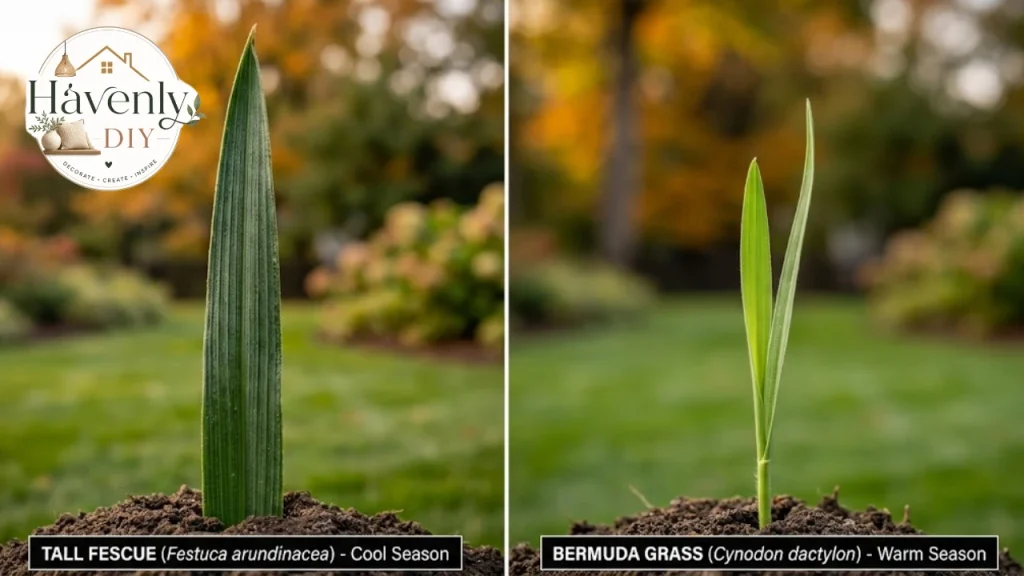
Match the Grass to the Light
Walk your yard at different times of day. Full sun, dappled shade, and deep shade each call for a different blend.
Shady lawns under mature oaks and maples need a shade-tolerant mix and extra patience. If less than a few hours of direct sun reach a spot, grass may never thrive there, and mulch or groundcover can be the better answer.
Start With a Soil Test
A soil test is the cheapest step in any lawn plan, and it removes a lot of guesswork. It reports pH and nutrient levels, and it tells you how much lime or fertilizer to add.
Virginia Cooperative Extension suggests sampling in summer, with samples mailed around mid-August so the results arrive before fall tasks begin. A county lawn calendar also advises retesting every two to three years.
Take small samples from several spots across the lawn, mix them in a clean bucket, and send the blend to the lab. Your local Extension office can explain the process and the current fee.
Acidic clay soil often needs lime. Extension guidance says to follow the soil test, apply no more than 50 pounds per application every 30 days, and avoid applying to frozen ground.
A Seasonal Lawn Calendar for Fredericksburg
This lawn care Fredericksburg,g VA calendar blends Virginia Cooperative Extension guidance with a local lawn guide. Dates shift with the weather, so use them as a frame and adjust to your own lawn. The focus is cool-season lawns, which most Fredericksburg yards are.
| Season | Main jobs |
|---|---|
| Late winter | Order seed and supplies, service the mower, plan pre-emergent weed control, test soil if due |
| Early spring | Start mowing when grass is growing, treat broadleaf weeds as needed, apply pre-emergent for crabgrass |
| Late spring | Mow weekly, fertilize lightly only if needed, spot-treat weeds |
| Summer | Raise the mower, water deeply and rarely, watch for brown patch and grubs |
| Early fall | Core aerate, overseed, start the fall feeding schedule |
| Late fall | Second feeding, mulch leaves, final mow, drain irrigation |
| Winter | Rest, stay off frosted grass |
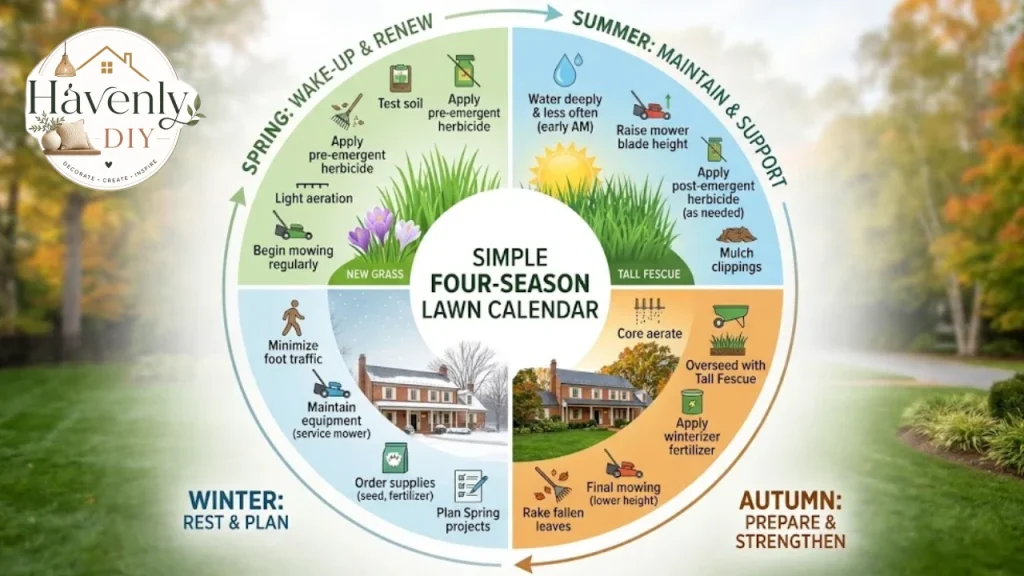
The most important point is that fall does the heavy lifting for fescue. A county Extension calendar recommends fall feeding for cool-season lawns and discourages heavy spring fertilizing.
Mowing for a Thicker Lawn
Mowing is the one job almost everyone does, and small changes pay off quickly.
Mow high. Extension guidance lists 3 to 4 inches for cool-season lawns, and 4 inches in summer. Taller grass shades the soil, resists weeds,ds and grows deeper roots.
Follow the one-third rule. Never remove more than a third of the blade at a time. If the grass gets away from you, cut it in stages over a few days.
Keep the blade sharp. A dull blade tears grass and leaves ragged brown tips. Sharpen it at least once a season, and before the fall growth surge.
Leave the clippings. They return nutrients and break down fast if the lawn is cut regularly.
Changing Heights Through the Year
Start spring mowing when the grass is actively growing, and let it grow to about 3 inches before the first cut. Raise the deck for summer, then lower it slightly in late fall for the final mow.
Sources vary on the exact final height, from about 2 to 3 inches. Avoid scalping, and don’t go lower than your regular height by more than an inch or so.
Watering the Right Way
Clay soil changes how you water. It absorbs slowly, so fast, heavy watering runs off.
A local guide recommends about 1 inch of water per week, including rainfall, applied deeply and infrequently. That encourages roots to reach down instead of staying shallow.
Water early in the morning, when winds are calm and the sun is low. Evening watering leaves grass wet overnight, which feeds fungus.
The Tuna Can Test
To measure what your sprinklers deliver, set empty cans on the lawn and run the system for 30 minutes. Measure the water in each can, and adjust the run time until you reach the target.
If puddles form before the time is up, split the session into two shorter cycles with a break in between.
Watering New Seed
Seedlings need a different routine. Extension guidance says new seed should be kept moist, about half an inch daily and sometimes twice a day, and never allowed to dry out.
Once seedlings are established, shift to about half an inch every two to three days, adjusting for weather.
Fertilizing, and the Virginia Rules to Know
In lawn care efforts in Fredericksburg, VA, fertilizer is where good intentions go wrong. More is not better, and the law here sets some limits.
What Virginia Law Says
Virginia Code § 3.2-3607 restricts lawn fertilizer. Since December 31, 2013, lawn maintenance fertilizer may not contain more than zero percent phosphorus, with certain exemptions, such as products intended mainly for gardens, trees, and shrubs.
The law also says that, since July 1, 2014, lawn fertilizer must provide nitrogen at rates consistent with Virginia’s recommended turfgrass rates. The text I reviewed doesn’t give a single numeric limit, so follow the label.
Phosphorus-free products are easy to find, and a soil test will tell you if a particular nutrient is truly needed. Check current rules with the Virginia Department of Agriculture and Consumer Services if you have questions, because laws can change.
How Much and When
Extension guidance for cool-season lawns recommends putting most nitrogen on in fall. One county calendar gives these figures:
In fall, no more than 0.9 pounds of nitrogen per 1,000 square feet per application if the product has at least 15 percent slow-release nitrogen, or 0.7 pounds if it has less.
In spring, if you must fertilize, make a single application of no more than 0.5 pounds per 1,000 square feet.
Most cool-season lawns need no more than 2 to 2.5 pounds per 1,000 square feet per year.
A separate Extension lawn schedule suggests feeding at about Columbus Day weekend and again around Veterans Day weekend, with a lighter spring feeding only if the fall feeding was skipped or the lawn struggles.
Other calendars schedule spring feeding earlier. When sources disagree, the Extension advice is the safer guide for fescue, because heavy spring growth stresses the grass going into summer.
Slow-Release Is Safer
Slow-release nitrogen feeds gradually, which lowers the risk of burn and runoff. Sweep any granules off driveways and sidewalks, so they don’t wash into storm drains and local waterways.
Controlling Weeds Without Wrecking the Lawn
A thick lawn is the best weed control. Most weeds move into thin, bare, or stressed turf.
Know What You Are Fighting
Identify the weed before choosing a product. Extension guidance says identification should come first, because different weeds need different treatments.
Crabgrass. A summer annual that sprouts in spring. Pre-emergent herbicide before it germinates is the standard approach.
Broadleaf weeds. Dandelion, clover, plantain, chickweed,d and similar plants. Extension lists winter and early spring, and again in fall, as treatment windows, and post-emergent products work when the weeds are actively growing.
Weedy grasses. Some, such as tall fescue clumps in a bluegrass lawn, are better handled by renovation than spraying.
Timing Pre-Emergent
A local guide gives a pre-emergent window from about February 8 to March 8, and elsewhere ties timing to forsythia and redbud bloom, with soil near 50 to 55 degrees Fahrenheit. Soil temperature is the more reliable trigger.
Pre-emergent herbicide prevents seed from sprouting, and that includes grass seed. Don’t apply it if you plan to overseed in the same season.
When the Lawn Is Mostly Weeds
Extension guidance says that if half or more of the lawn is weeds or weedy grasses, consider a more extensive renovation rather than spot treatments. That often means killing the area, reseeding,g and rebuilding the soil.
Some herbicides interfere with overseeding, so check labels or call your local Extension office before combining treatments.
Overseeding and Aeration: The Fall Reset
If you only do one big job each year, make it this one. Overseeding and aeration fix thin lawns, bare patches,es and compacted clay all at once.
Core Aeration
A core aerator pulls small plugs of soil out of the ground. This opens the surface so air, water and seed reach the roots.
Extension guidance recommends core aerating around Labor Day. If the soil is very dry, water the day before so the tines penetrate.
Rental aerators are common. One county Extension document listed rentals at about 80 dollars a day, but prices change, so call around.
If you can’t get a core aerator, Extension suggests alternatives such as a rake, vertical mower or dethatching machine to create seed-to-soil contact. These are less effective on hard clay.
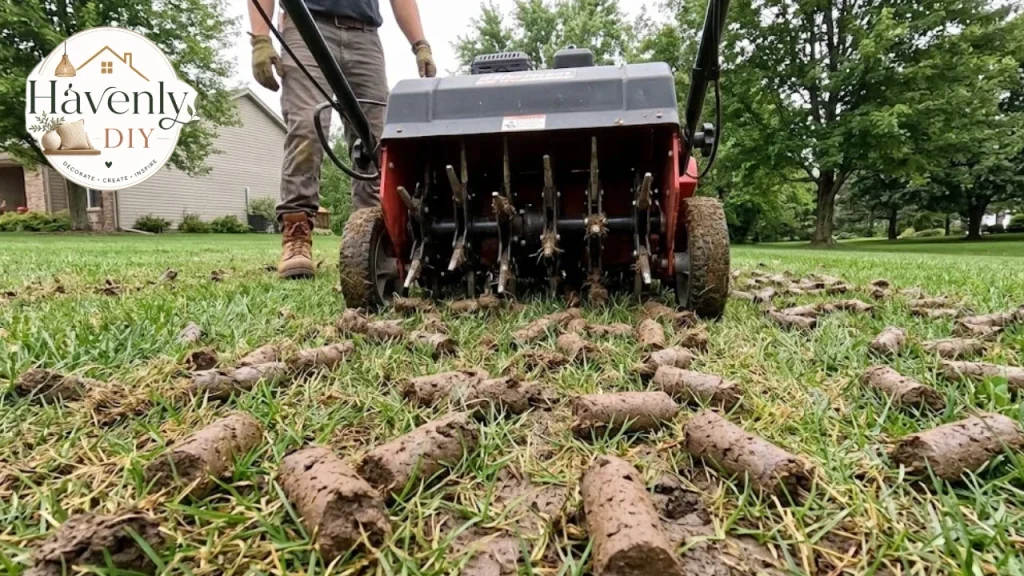
Overseeding Steps
Mow the lawn a bit lower than usual and bag the clippings.
Core aerate in two directions.
Spread seed with a drop or broadcast spreader. Extension suggests at least 2 to 3 pounds per 1,000 square feet, The extensiong 2 to 4 pounds.
Add extra seed to bare spots.
Top-dress with a thin layer of fine compost, about a quarter to half an inch, if you can.
Water lightly and often until seedlings are established.
Don’t fertilize at the time of overseeding, according to the same Extension guidance. Fertilize later in fall instead.
Why Fall Beats Spring
Fall brings warm soil, cooler air and less competition from weeds. Seedlings have months to build ,roots before summer heat.
One local guide describes September as the key fescue month and says spring seeding often fails because summer stress arrives too soon. Another source lists a window running from late August through mid-October, so aim for early fall and avoid waiting too long.
Choosing Seed
Buy certified seed with a clear label. Check the mix, the germination rate and the weed seed percentage.
Look for improved fescue varieties and blends suited to your light conditions. Cheap mixes often contain filler grasses that don’t last.
Pests and Problems to Watch For
Grubs and Japanese Beetles
A local guide notes that Japanese beetle grubs damage roots from August through October. Signs include spongy turf, irregular brown patches, and lawn that lifts like carpet.
Birds, moles or skunks digging up the lawn can also point to grubs. Check by cutting a square foot of turf and peeling it back. Extension guidance says control is “if needed,” so confirm a real problem before treating.
Chinch Bugs and Sod Webworms
These can cause dry, yellow patches in hot, sunny areas. County Extension material lists them as pests to control only when necessary.
Brown Patch and Other Diseases
Brown patch shows up in hot, humid weather as circular patches with a smoky edge. Prevent it by watering in the morning, avoiding heavy summer nitrogen and mowing with a sharp blade.
County Extension guidance states that fungicides are generally not recommended for home lawns. A strong, well-managed lawn recovers when fall weather returns.
Compaction and Thatch
Heavy clay compacts under foot traffic and mowers. Core aeration every year or two keeps it open.
A thin thatch layer is normal. If it gets thicker than about half an inch, talk to your Extension office about dethatching.
Leaves in Fall
Mulch a light layer of leaves into the lawn with your mower. For heavy leaf cover, rake or collect them, since a thick mat blocks light and invites disease.
Compost leaves or use them as garden mulch.
Lawn Care and Your Home’s Style
Your yard frames your house. A low, wide ranch-style home looks best with a clean, simple lawn and wide planting beds, while a historic home with detailed trim may suit more formal edges.
If you’re planning a home addition, protect the lawn during construction. Heavy equipment compacts clay quickly, and fencing off the root zones of mature trees saves expensive repairs.
Plan to aerate and overseed the first fall after any building project, since construction traffic leaves soil hard and thin.
Doing It Yourself or Hiring a Service
Many homeowners can handle mowing, watering,g and seeding. Others prefer help, especially with weed and fertilizer programs.
When DIY Makes Sense
DIY works well when you enjoy yard work, have a modest lot, and own or can rent the right tools. Soil testing, aeration and overseeding are within reach of most people.
When to Hire a Pro
Consider hiring help if you have a large property, limited time, a physical limitation,n or a persistent problem like grubs or heavy weeds. A good company handles scheduling, equipment and product handling for you.
For lawn care in Fredericksburg, VA re, residents who work long commutes toward Northern Virginia can find that a weekly mowing service can free up Saturdays.
What Does It Cost?
One local price guide reports estimates for the Fredericksburg market. These are estimates from a single commercial source, which says its figures are adjusted for local labor and material costs and that the area runs above the national average.
| Service | Estimated cost (USD) |
|---|---|
| Weekly mowing | 63 to 188 per visit |
| Lawn and garden cleanup | 188 to 500 per visit |
| Core aeration | 94 to 250 per visit |
| Overseeding | 188 to 438 per visit |
Treat these numbers as a rough starting point. Prices depend on lot size, access, slope and the season, and I could not verify them against other independent sources. Get at least three written quotes before you commit.
How to Choose a Company
Ask about licensing and insurance. If the company applies herbicides, ask whether its applicators hold the state certification for commercial pesticide work.
Request a written scope. It should list services, frequency, products and price.
Check reviews and references. Look for patterns, not single comments, and ask neighbors.
Ask about fertilizer. The company should use phosphorus-free lawn products and follow label rates.
Avoid pressure. Be cautious of door-to-door offers with big discounts for signing today.
Compare contract terms. Look for cancellation rules and what happens in a drought or storm.
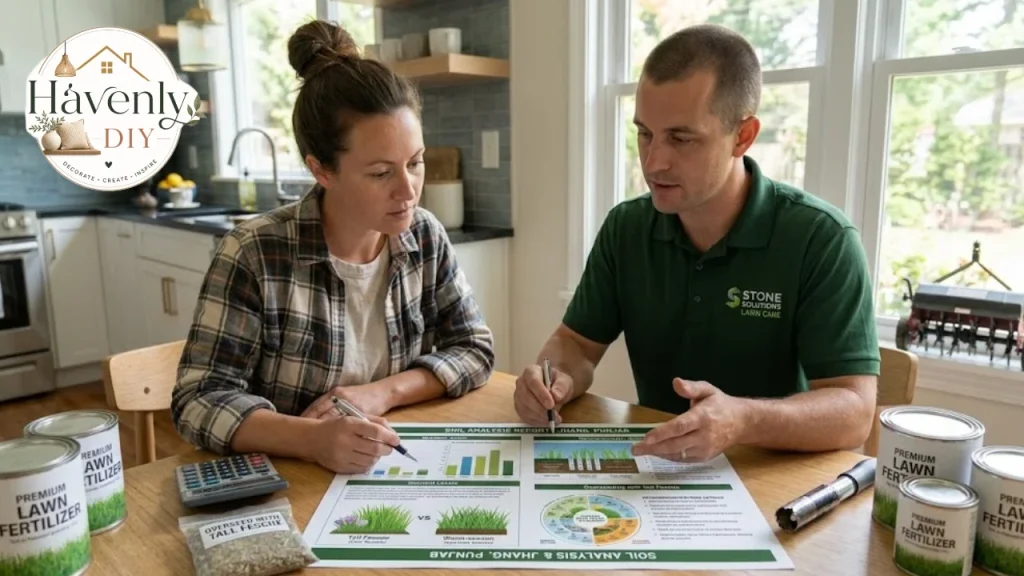
Common Mistakes to Avoid
Mowing too short. Scalping weakens roots and lets weeds in.
Fertilizing at the wrong time. Heavy spring feeding of fescue pushes soft growth into summer.
Overwatering. Daily light watering grows shallow roots and invites disease.
Skipping the soil test. Guessing at lime and fertilizer wastes money.
Overseeding too late. Seedlings need time to mature before winter.
Using pre-emergent and seeding together. The product can stop your new grass too.
Ignoring compaction. Clay needs regular aeration.
Treating without identifying. The wrong herbicide wastes money and can harm the lawn.
Letting runoff happen. Fertilizer on driveways ends up in storm drains.
Buying cheap seed. Poor mixes fail and cost more in the end.
FAQs:
What is the best grass for lawns in Fredericksburg, VA?
For lawn care Fredericksburg VA residents, tall fescue, often blended with some Kentucky bluegrass, is the most common choice. Bermuda can work in full sun, but it turns brown in winter.
When should I fertilize my lawn in Fredericksburg?
For cool-season lawns, Extension guidance favors fall feeding, with a light or no spring application. Follow your soil test and the product label.
When should I overseed in Fredericksburg?
Early fall, around Labor Day, is the standard recommendation, with some sources extending the window into mid-October. Spring seeding is less reliable.
Is phosphorus allowed in lawn fertilizer in Virginia?
Under Virginia Code § 3.2-3607, lawn maintenance fertilizer sold or used in the state can’t contain phosphorus, with listed exemptions. Check the current law for details.
How often should I water?
Aim for about 1 inch per week including rain, applied deeply and less often. New seed neemore frequent,ent lighter watering.
Why is my lawn thin in summer?
Tall fescue slows down in heat, and July and August stress can thin it. Mow high, water deeply and plan to overseed in fall.
How much does lawn service cost in Fredericksburg?
One local guide estimates weekly mowing at 63 to 188 dollars per visit, but prices vary. Get several written quotes.
Can I do lawn care myself?
Yes, in most cases. Mowing, watering, seeding and aeration are manageable for a motivated homeowner. Hire a pr,ofessional for large lots or persistent pest problems.