

A low slope roof looks flat from the street, but it is built to drain. A slight tilt carries rain to a drain, scupper,r or gutter, and the covering on top has to be waterproof, not just water-shedding.
That difference drives every choice here. A low slope roof can’t use the coverings a steep roof uses, and small drainage mistakes turn into leaks.
This guide covers what counts as a low slope roof, the minimum pitch, materials, costs,ts and drainage. Where sources disagree, I show both views and name each source.
What Counts as a Low Slope Roof?
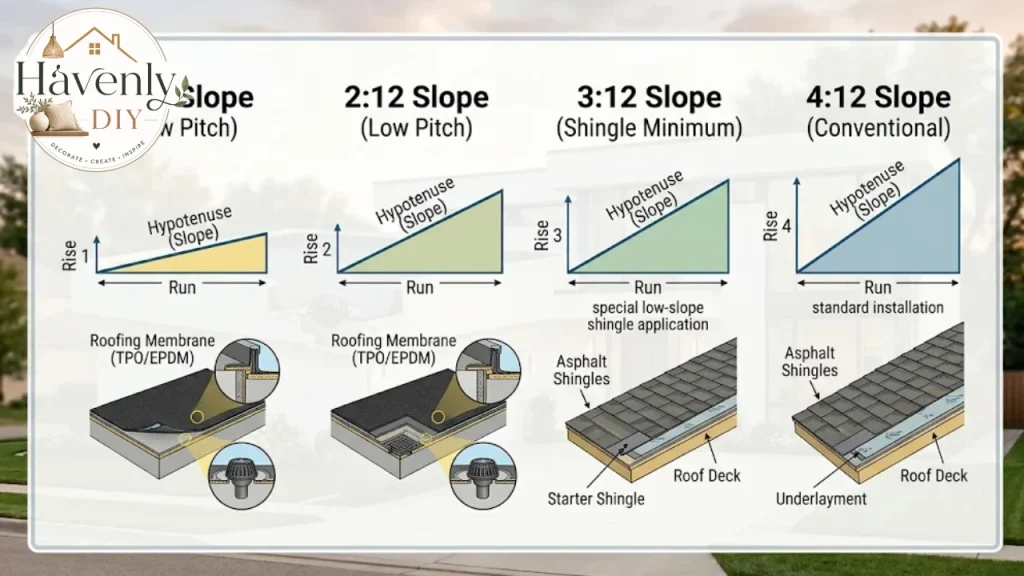
Slope is rise over run: inches of vertical rise per 12 inches of horizontal distance. A 2:12 roof rises 2 inches for every 12.
Definitions differ. In the roofing-company pages I saw in search results, the cutoff is variously 2:12, 3:12, or 4:12. The U.S. Department of Energy’s cool roof guide (February 2011) uses a pitch of 2:12 or less.
IKO (November 22, 2023) splits it differently. It says a granule-surfaced asphalt membrane can go below 2:12, and that most manufacturers want special underlayment between 2:12 and 4:12.
The table converts common slopes. This is my arithmetic, and the code rounds ¼:12 to 2 percent.
| Slope | Percent | Angle | Fall over a 20 ft run |
|---|---|---|---|
| ¼:12 | 2.1% | 1.2° | 5 in |
| ½:12 | 4.2% | 2.4° | 10 in |
| 1:12 | 8.3% | 4.8° | 20 in |
| 2:12 | 16.7% | 9.5° | 40 in |
| 3:12 | 25% | 14.0° | 60 in |
| 4:12 | 33.3% | 18.4° | 80 in |
A 5-inch drop across 20 feet is barely visible, which is why a low-slope roof gets called flat.
Low Slope vs Flat
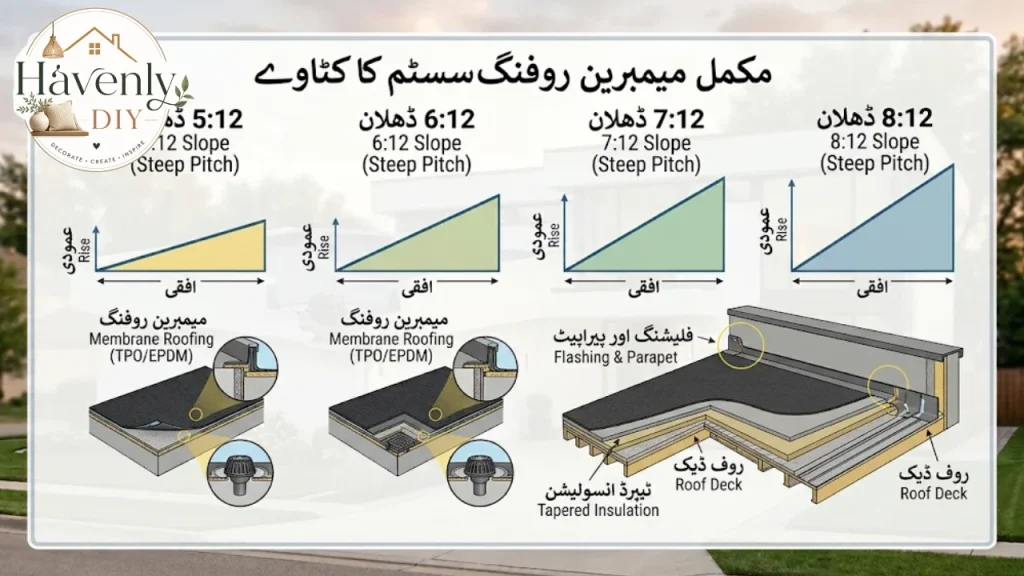
A truly flat roof has no pitch at all, and the minimums quoted below don’t allow for one. Every membrane source here still asks for at least ¼:12.
In practice, a roof called flat should be treated as a low-slope roof with a drainage plan. If the deck is level, the slope has to come from tapered insulation, sloped fill, or reframing.
Minimum Slope: What Code and Experts Say
The 2024 residential code, as quoted by independent roof consultant Jack Gray (updated October 28, 2025), says single-ply membranes need a design slope of at least ¼ unit in 12, a 2 percent slope.
Roofing Magazine (Marcin Pazera, September 27, 2019) reports the same ¼:12 minimum for membrane systems in the 2018 commercial code, and 1/8 inch per foot for coal tar pitch roofs.
Pazera adds that re-covering an existing roof that already drains is exempt from the minimum. An older roof can legally sit flatter than a new one would be allowed.
Is the minimum enough? Gray says ½:12 or more helps reduce ponding. Polyglass (July 21, 2025, a manufacturer blog) says 1/8 inch per foot is not enough where rain or snowmelt is heavy.
Engineer Frank Woeste (Journal of Light Construction, July 29, 2021) goes further. In his model, a 20-foot span of 2×10 joists built at ¼ inch per foot starts 5 inches higher on one side. Once the wood creeps under load, the last 4 feet slope backward.
He recommends 3/8 or ½ inch per foot instead. By my arithmetic, that is 7.5 or 10 inches of fall over 20 feet.
| Covering | Minimum slope | Source |
|---|---|---|
| Single-ply (EPDM, TPO, PVC) | ¼:12 | Gray, 2024 IRC |
| Membrane systems | ¼:12 | Pazera, 2018 IBC |
| Coal tar pitch | 1/8 in per foot | Pazera |
| Standing seam metal | ¼:12 | Gray, 2024 IRC |
| Lapped metal with sealant | ½:12 | Gray, 2024 IRC |
| Lapped metal without sealant | 3:12 | Gray, 2024 IRC |
| Asphalt shingles | 2:12 absolute minimum, 4:12 standard | IKO |
Local code and manufacturer instructions can be stricter, so check both before you buy.
Low Slope Roof Materials
The right low slope roof material is one with continuous seams. Shingles shed water downhill. Membranes and metal seams hold it out even when it sits for a while.
Angi calls single-ply membranes such as EPDM, TPO, and PVC a strong fit for low-slope roofs. It lists low maintenance and lower labor as pros. It lists thin membranes that tear easily and seams that can leak as cons.
Cool Roofs, Inc. (June 22, 2026) is a contractor, so read its pros and cons as ideas. Most of the notes below come from its page.
EPDM
EPDM is the black rubber membrane. Cool Roofs says it stays flexible in extreme cold and resists UV and ozone. Its listed weakness is that the standard black surface absorbs more heat than reflective options.
Taped or adhesive seams need careful installation and close inspection.
TPO
TPO is the white or light membrane with heat-welded seams. Cool Roofs lists a reflective surface and lower material cost than PVC.
The same page warns that quality varies by manufacturer and thickness, and that installer experience matters more than with most systems.
PVC
PVC is also heat-welded and reflective. Cool Roofs says it has the best chemical and grease resistance of the single-ply options, which may suit a roof near a kitchen exhaust (my inference).
It costs more upfront, and older formulations could turn brittle as plasticizers leached out.
Modified Bitumen and Built-Up Roofing
Modified bitumen is a rolled asphalt membrane. Cool Roofs credits it with strong puncture and storm resistance, and says it can be repaired in sections. Dark cap sheets absorb heat, and torch-down installation uses an open flame.
Built-up roofing (BUR) stacks layers for redundancy. The same page says it is heavy and that gravel surfacing makes small leaks harder to spot.
Metal and Spray Foam
Gray says standing seam is the better choice for very shallow pitches, and that unsealed lapped panels at the 3:12 minimum are “not ideal” because wind can push water into the laps.
Spray foam appears in a cost table from roofcalc.org (October 16, 2023), a lead-generation site, at 20 to 40 years. I found no independent source on it, so treat that as a lead to check.
Low Slope Roof Cost and Lifespan
The cost of a low slope roof varies widely, and so do the sources. The table shows installed cost per square foot and lifespan from three pages, in USD.
| Material | Angi (no date shown) | Cool Roofs, Inc. (June 2026) | roofcalc.org (October 2023) |
|---|---|---|---|
| EPDM | 5 to 13; 30 to 40 yrs | 4 to 7; 25 to 30+ yrs | 5.50 to 6.50; 10 to 15 yrs |
| TPO | 4 to 14; 15 to 30 yrs | 5 to 9; 20 to 30 yrs | 6 to 7; 20 to 30 yrs |
| PVC | 5 to 15; 20 to 30 yrs | 6 to 12; 20 to 30 yrs | 6.50 to 7.50; 30 to 50 yrs |
| Modified bitumen | 4 to 8; no lifespan | 4 to 10; 15 to 25 yrs | 5.50 to 6.50; 12 to 20 yrs |
| Built-up | 4 to 10; no lifespan | no price; 20 to 30+ yrs | no row |
| Spray foam | no row | no row | 4.50 to 7; 20 to 40 yrs |
The biggest gap is EPDM lifespan: 10 to 15 years on one page, 30 to 40 on another. The pages also contradict themselves. Angi gives a general single-ply range of 7 to 30 years and captions EPDM “up to 15 years.” roofcalc.org lists TPO at 7 to 20 years in one place and 15 to 20 in another.
My read: the price ranges overlap, so cost alone won’t choose for you. Lifespan claims depend on installation, drainage, and maintenance more than on the membrane name.
For a 1,500 square foot roof, my arithmetic on the Cool Roofs ranges gives these totals:
- EPDM: 6,000 to 10,500 USD
- TPO: 7,500 to 13,500 USD
- PVC: 9,000 to 18,000 USD
- Modified bitumen: 6,000 to 15,000 USD
Angi’s widest range, 4 to 15 per square foot, would stretch that to 6,000 to 22,500 USD.
Quotes also swing with roof size, the number of drains, vents,s and curbs, and whether the old roof must come off. I found no dependable price for tapered insulation, new drains,s or tear-off, so none is included. Ask for each as a separate line in every quote.
For repairs, roofcalc.org says a typical flat roof repair runs at least 350 to 400 USD, and severe damage can pass 600 to 800 USD. That is one lead-generation page, so treat it as a rough guide.
Drainage and Ponding
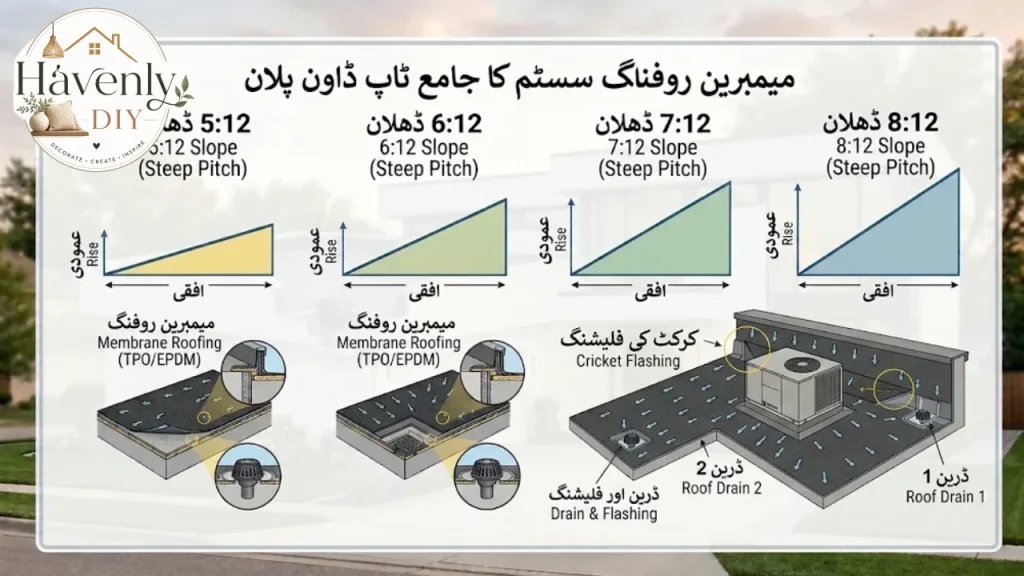
Ponding is water that stays on the roof after rain. Polyglass defines it as pools lasting 48 to 72 hours, and the 2018 commercial code, as quoted by Pazera, defines positive drainage as water gone within 48 hours.
Polyglass lists four causes: too little slope, too few drains, a sagging deck, and missing crickets behind curbs or equipment. A cricket is a small raised saddle that sends water around an obstacle.
The fixes mirror the causes. Pazera, citing the National Roofing Contractors Association manual, lists these ways to build slope:
- Slope the framing or deck.
- Use tapered insulation.
- Use an insulating fill that can be sloped.
- Place drains, scuppers, and gutters at the low points.
Why it matters: Gray says EPDM, PVC, and TPO membranes “are not designed to sit under standing water for prolonged periods.” Water also weighs 62.4 pounds per cubic foot, so by my arithmetic each inch adds 5.2 pounds per square foot. One inch across 1,000 square feet is 5,200 pounds.
My suggestion: after rain, mark the water’s edge with tape and check it 48 hours later. If it hasn’t shrunk, call a roofer.
Insulation and Energy
Many low-slope roofs are white or light because color changes heat. The Department of Energy guide (February 2011) says cool thermoplastic membranes, coatings, and metal products exist for roofs at 2:12 or less.
It puts annual savings at up to 0.20 USD per square foot for a commercial white roof and up to 0.05 for a home with a cool-color roof. Those are 2011 figures, so prices have likely moved.
The guide warns that a cool roof may raise winter heating needs. It also says replacing a sound roof just to raise reflectance is rarely economical, so choose cool when a replacement is already due.
Maintenance Checklist
roofcalc.org (October 2023) suggests this routine, once a year and after major storms or freeze-thaw cycles:
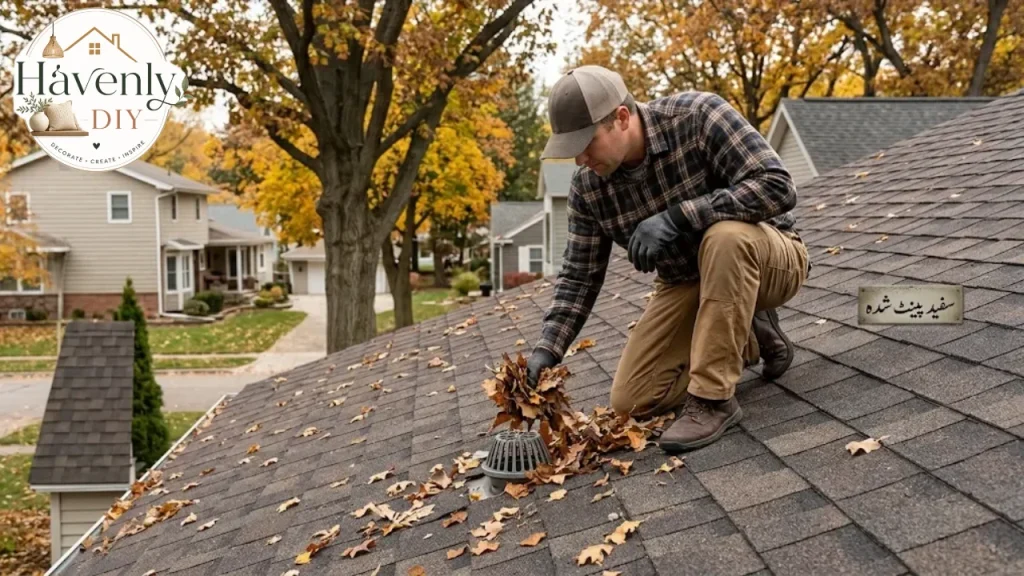
- Remove debris such as moss and sticks.
- Inspect seams and flashings for wear.
- Keep drains and scuppers clear.
- Have a specialist check for hidden moisture, since rot may not show on the surface.
It adds that EPDM may need re-seaming every 7 to 10 years once the adhesive fails. That is one contractor’s claim, so confirm it with your manufacturer.
Common Mistakes
Using shingles below their minimum. IKO calls 2:12 the absolute minimum and suggests a membrane below it.
Designing to exactly ¼:12. Woeste shows that sag can erase it.
Forgetting equipment weight. Woeste says to put HVAC units on the plans.
Leaving ponding for weeks. Check after 48 hours.
Skipping the code check. Local rules may be stricter than the model code.
DIY or Hire a Pro?
A small low slope roof over a porch is tempting to do yourself. Welded or taped seams, flashing, and drainage are where mistakes show up, though. Gray warns that errors in seam sealing or flashing can compromise the whole system.
I’m not an engineer or a roofer, and permits and codes vary by city. For a deck that sags, get a pro’s opinion before you cover it.
FAQs:
What is a low slope roof?
A roof with a shallow pitch, usually 2:12 or less, though some pages stretch the cutoff to 3:12 or 4:12. It needs a waterproof membrane or sealed metal, not ordinary shingles.
What is the minimum slope for a low slope roof?
The 2024 residential code, quoted by Jack Gray, sets ¼:12 (2 percent) for single-ply membranes. Gray and Frank Woeste both suggest more, from ½:12 up.
Can I use shingles on a low slope roof?
IKO says 2:12 is the absolute minimum for asphalt shingles and 4:12 is the standard. Below 2:1,2 it points to a granule-surfaced membrane. Check your shingle manufacturer and local code.
What is the best material?
No source names one winner. EPDM, TPO, and PVC are the common single-ply choices, and standing seam metal suits very shallow pitches. Match the material to your drainage and budget.
How much does a low slope roof cost?
Costs range from about 4 to 15 USD per square foot installed. See the cost table, and get tapered insulation and drains quoted as separate lines.
How long can water sit on the roof?
More than 48 hours counts as ponding under the 2018 code definition quoted by Marcin Pazera. Polyglass puts the range at 48 to 72 hours.
Do I need tapered insulation?
If your deck is flatter than ¼:12, Pazera lists tapered insulation as one way to create slope. Framing slope, sloped fill, and drain placement are the others.
How do I choose a low slope roof for an addition?
Start with drainage. A low slope roof on an addition needs a clear path for water to leave. Read our home additions guide for planning, then compare quotes on the same slope and detail.