

Water in the wrong place is one of the most common yard problems. It shows up as puddles that last for days, a lawn that squishes underfoot, or damp patches along the foundation.
The right yard drainage solutions depend on why the water is there. A downspout dumping at the corner of the house needs a different fix than a clay lawn that never dries.
This guide shows how to diagnose the cause, then walks through nine fixes with slopes, depths, costs, and safety limits from extension and government sources. Where sources disagree, I show both numbers.
Why Yards Hold Water
Purdue Extension’s stormwater page for Putnam County (its web address is dated April 2025) lists the usual causes. They include back-to-back rain on saturated soil, soil compaction, a high water table, very high clay, and damaged downspouts, gutters, or drainage tile.
Washington State University Extension in Clark County adds roof runoff, water arriving from neighboring properties,s and compaction from heavy machinery.
Roof water is often the biggest factor. MyRainPlan, a company blog (March 2026), says a 1,000 square foot roof sheds over 600 gallons from one inch of rain. By my arithmetic, 1,000 square feet times one inch is about 83 cubic feet, or roughly 620 gallons. That volume has to go somewhere.
Diagnose Before You Dig
Walk the yard during or right after a storm. Note where water pools, where it runs,ns and how long it stays. The table matches common symptoms to a first fix.
| What you see | Likely cause | Start with |
|---|---|---|
| Puddle at a downspout outlet | Roof water dumped too close | Extend or disconnect the downspout |
| Water runs toward the house | Grade slopes the wrong way | Regrade or add a swale |
| Low spot holds water for days | Depression, clay or compaction | Fill, aerate, or add a drain or rain garden |
| Soggy even without rain | High water table or spring | Rain garden or drain, ideally with a pro |
| Water arrives from a neighbor | Run-on from higher ground | Swale or berm |
| Gullies in the lawn | Fast flow on a slope | Grassy swale |
Home Depot’s drainage guide (April 5, 2024) says areas that stay soggy without recent rain may sit over underground springs, and suggests a rain garden there.
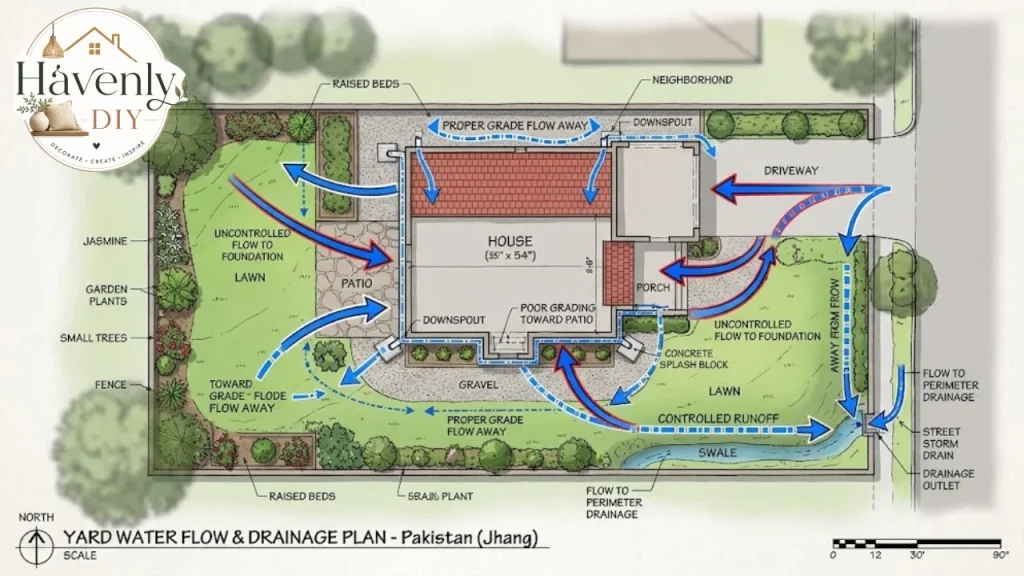
My suggestion: the day after a storm, put a flag at every pooling spot and photograph it. A simple map saves you from fixing the wrong place.
Grade and Slope Basics
Grading is the cheapest of the yard drainage solutions when it works, and the rules for it are often written into local code.
The 2022 California Building Code, quoted in a City of Hemet handout (May 23, 2024), calls for a 5 percent slope away from the foundation for at least 10 feet. That is the same as 6 inches of fall in 10 feet,
per a City of Caldwell document. The code allows 2 percent where climate or soil conditions warrant, and slopes hard surfaces within 10 feet at 2 percent.
Ware Landscaping, a company blog, says at least 2 percent, or 2 inches per 10 feet. By my arithmetic, 2 inches in 10 feet is about 1.7 percent, and a true 2 percent is about 2.4 inches. The gap matters, so check your local code before you set grades.
If you have a single-story layout, our ranch style home guide covers the footprint, and the same grading rules apply to its foundation. If you are building on, our home additions guide is worth reading first, since new construction changes where water goes.
Nine Yard Drainage Solutions
These yard drainage solutions run from nearly free to a major dig. Start at the top and move down only if the cheaper fix doesn’t solve it.
Extend or Disconnect Downspouts
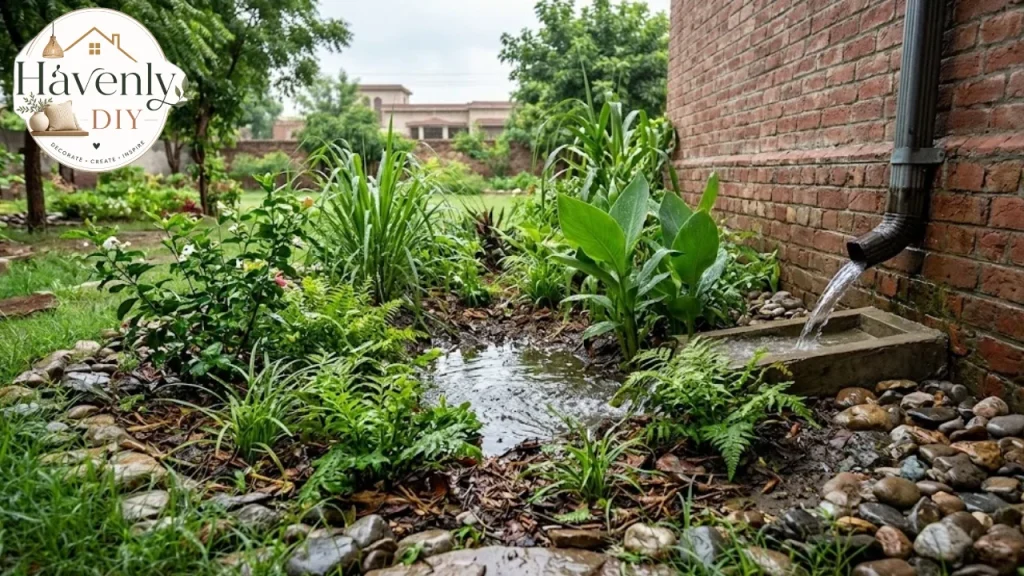
Purdue Extension says to send roof water to lawn, landscaped beds, porous pavement, a rain garden, a swale or a rain barrel, and not to a paved surface, storm drain or ditch.
A City of Portland brochure (ES1919, updated February 2020) gives distances. Discharge at least 6 feet from basement walls and 2 feet from a crawl space or slab. Keep the end at least 5 feet from a neighbor’s property line and 3 feet from a public sidewalk.
Do It Best, a retailer, says flexible tubes move water another 4 to 6 feet. That is shorter than Portland’s basement rule, so measure and follow the longer number if you have a basement.
Portland also says not to disconnect where the slope is over 10 percent, within 10 feet of a retaining wall, or over a septic system.
Regrade the Yard
Regrading reshapes soil so water flows away. LawnStarter prices it at 0.08 to 2.00 dollars per square foot, or 310 to 6,910 dollars for most jobs. MyRainPlan puts grading or downspout fixes at 200 to 800 dollars.
Dig a Swale
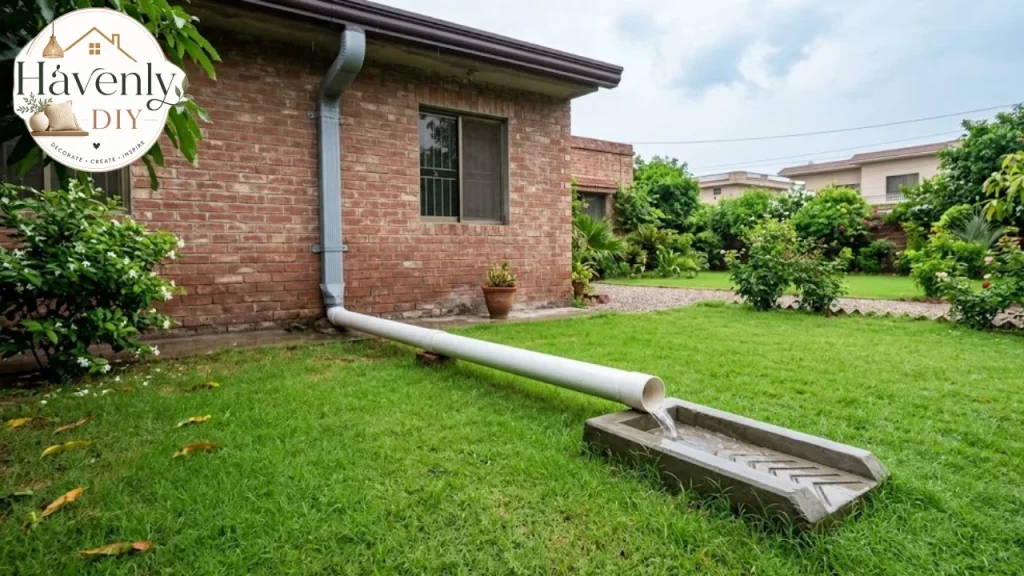
A swale is a shallow, gently sloped channel that carries water to a safe place. The Building America Solution Center at PNNL (last updated September 27, 2020) gives specifics.
Side slopes should be no steeper than 3 to 1, and the long slope should hold between 2 and 4 percent. Under 2 percent can pool water, and over 4 percent can erode.
The top 8 inches of soil should drain well, and PNNL says to avoid compacting the trench. WSU adds that a swale should hold water no longer than 48 to 72 hours to limit mosquitoes, with grass kept at least 3 to 4 inches tall.
Home Depot says a drain or swale needs at least a 1 percent slope. That is lower than PNNL’s 2 percent floor for swales, so treat 2 percent as the safer target. LawnStarter prices a swale at about 50 cents per square foot.
Install a French Drain
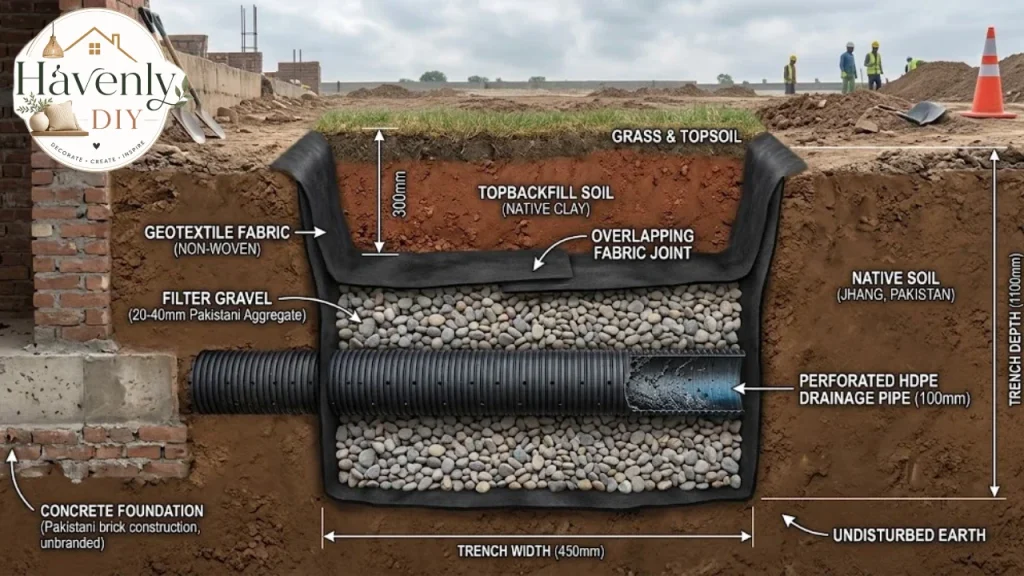
A French drain is a trench with filter fabric, gravel and a perforated pipe. WSU says it intercepts water crossing a slope or collects downspout runoff, and works best outside the groundwater table.
PNNL gives a build: a trench at least 22 inches deep and 14 inches wide, 8-ounce filter fabric, 4 inches of three-quarter-inch clean rock at the base, 4-inch perforated PVC with holes down, then rock over the pipe. It prefers smooth PVC to corrugated pipe, which clogs more easily.
Slope numbers differ. WSU says 0.5 to 1 percent, or a 1 foot drop over 100 feet. Home Depot says at least 1 percent, or 1 inch per 10 feet. By my arithmetic,
1 inch in 10 feet is about 0.83 percent, so Home Depot’s two statements don’t quite match. Aim for at least 1 percent and confirm the outlet sits lower than the inlet.
Build a Dry Well
A dry well is a gravel-filled pit lined with fabric that lets roof runoff soak into the soil. WSU says it should drain fully within 48 hours, and sit at least 10 feet from foundations and 75 feet from wells, septic systems, and surface water.
PNNL describes a 4-by-4-foot hole, 4 to 6 feet deep, filled with clean three-quarter to 1.5-inch rock. WSU says dry wells suit small areas with little sediment, and may need an overflow for large volumes.
LawnStarter puts a DIY dry well at 185 to 385 dollars and a professional one at 1,165 dollars or more.
Add a Catch Basin or Channel Drain
A catch basin collects surface water at a low spot and sends it through a pipe to an outlet. A channel drain does the same along a driveway or patio edge, under a grate.
I found less independent detail on these than on the others. Either fix needs somewhere for the water to go.
Plant a Rain Garden
Purdue Extension describes a rain garden as a shallow depression planted with native or adapted species that tolerate wet and dry spells. It captures runoff from roofs and hard surfaces and should drain in 24 to 48 hours.
Homes & Gardens quotes LawnStarter’s Ryan Farley saying that in very heavy clay, as found across the South, a rain garden won’t solve the problem. He suggests mulch or a French drain instead.
Costs vary even within one publisher. LawnStarter’s standing-water guide says 7.25 to 27 dollars per square foot professionally, while its French drain guide lists 10 to 20 dollars professionally and 1 to 5 dollars DIY.
Lay a Dry Creek Bed
Farley calls a dry creek bed one of the cheapest French drain alternatives. It is a gravel or rock channel at the bottom of a slope that filters water into the soil, like a swale without grass. It won’t work in every yard.
Use Permeable Paving
Purdue Extension lists pervious concrete, porous asphalt, and permeable pavers, which let water seep through pores into the soil. I didn’t find a reliable cost figure.
Combine Fixes When Needed
The best yard drainage solutions are often a mix. Homes & Gardens notes you can hook a French drain up to a dry well, so the drain moves water and the well releases it slowly.
Comparing Yard Drainage Solutions
This table lines up the yard drainage solutions above. Costs are from online guides, not quotes, and amounts are in US dollars.
| Fix | Best for | Cost from sources | Limits |
|---|---|---|---|
| Downspout extension | Roof runoff pooling | About 4 per foot to replace | Needs room and slope |
| Regrading | Water toward the house | 0.08 to 2.00 per sq ft | Disturbs the lawn |
| Swale | Surface flow on slopes | About 0.50 per sq ft | Needs 2 to 4 percent slope |
| French drain | Persistent wet spots | 5,000 average, 1,650 to 12,250 | Needs an outlet |
| Dry well | Roof runoff | 185 to 385 DIY, 1,165 or more pro | Needs permeable soil |
| Catch basin | Low spots, hard surfaces | 500 to 3,500 add-on | Needs an outlet |
| Rain garden | Small depressions | 7.25 to 27 per sq ft pro | Weak in heavy clay |
| Dry creek bed | Slopes | No figure found | Not for every yard |
| Permeable paving | Patios, driveways | No figure found | Needs porous base |
Why French Drain Costs Disagree
LawnStarter (updated October 5, 2026) says the average French drain is 5,000 dollars, with most homeowners paying 1,650 to 12,250 dollars. Lawn Love’s 2026 guide puts the typical range at 2,800 to 6,500 dollars.
Per foot, LawnStarter lists 10 to 65 dollars for exterior drains. HomeAdvisor’s 2025 guide gives 30 to 90 dollars for a yard trench drain and 10 to 25 dollars for a shallow curtain drain.
By my arithmetic, 100 feet of yard drain at 30 to 90 dollars would be 3,000 to 9,000 dollars. LawnStarter says most of the cost is labor and equipment, and permits run 58 to 225 dollars. Get at least two local bids.
Fix the Soil and Lawn
Sometimes the problem is the soil, not the slope. Illinois Extension says core aeration comes first, then topdressing with organic matter. It also says severe compaction, high clay,y or poor drainage can require starting over.
Kansas State Extension says clay soil should be improved with organic matter such as compost before planting a lawn. To check for compaction, a Virginia Cooperative Extension fact sheet suggests removing a square foot of lawn at least 6 inches deep. If roots reach only about 2 inches, the soil may be compacted.
The same fact sheet says spiking is less effective than core aeration and can add to compaction. Aeration helps small problems, but it won’t fix a wrongly graded yard.
Plants for Wet Spots
If water must stand for a while, plant for it. WSU lists rushes, cattails,ls and sedges for longer standing water. PNNL suggests fine, close-growing grasses such as reed canary grass and red fescue in swales.
Keep shrubs and trees away from drain pipes, PNNL warns.
Permits, Utilities and Safety
Rules are local, so treat these as examples. WSU says a grading permit may be needed in Clark County, Washington, if you move 50 cubic yards or more of soil for a French drain, dry well, berm or swale. Your county may use a different number.
Septic systems matter. WSU wants dry wells 75 feet from septic systems and wells, and Portland says not to discharge a downspout over a septic system or drain field.
General advice, not from the sources above: call your local utility locating service before digging, check HOA rules, and tell neighbors if water will cross a shared boundary.
DIY or Hire a Pro?
The sources disagree on savings. Lawn Love prices a DIY 25-foot French drain with one catch basin at 528 dollars, or 21.12 dollars per foot, against 10 to 75 dollars per foot for a pro. It recommends professionals, since DIY may save little.
LawnStarter lists about $ 700 for DIY and about $ 3,000 for a professional.
My suggestion: DIY downspout extensions, gutter cleaning and small grading jobs. Call a pro for water at the foundation, long runs, a high water table or shared boundaries.
Common Mistakes
Sending water to a neighbor. Portland says the end should be at least 5 feet from the property line, and possibly more if the yard slopes that way.
Skipping the outlet. A drain needs somewhere lower to empty.
Planting over pipes. PNNL says to avoid shrubs and trees near drains.
Driving over the drain. WSU warns that machinery compacts soil and crushes pipes.
Building a rain garden in heavy clay. Farley says it won’t solve the problem.
Maintenance Checklist
- Clean gutters at least twice a year and clear downspout elbows, per Portland.
- After the first rainy season, add soil and finish grading where it settled, per PNNL.
- Mow swales when the soil isn’t saturated, and remove cuttings, per WSU.
- Check outlets after storms for erosion, per Purdue.
FAQs:
What is the cheapest way to fix a soggy yard?
Start with gutters and downspouts. Purdue and Portland both focus on moving roof water away. Regrading is next, at 0.08 to 2.00 dollars per square foot per LawnStarter.
How much slope does a yard need?
Codes call for 6 inches of fall in 10 feet near the foundation, with a 2 percent exception in some codes. PNNL says swales should run 2 to 4 percent, and WSU says French drains need 0.5 to 1 percent.
French drain or dry well?
A French drain moves water along a path, and a dry well stores and soaks it in. Homes & Gardens says you can connect the two. WSU limits dry wells to small areas with little sediment.
How far should downspouts discharge?
Portland says at least 6 feet from basement walls and 2 feet from a crawl space or slab. Do It Best says 4 to 6 feet for flexible tubes.
Will a rain garden fix clay soil?
Not in very heavy clay, per Farley. Purdue says a working rain garden drains in 24 to 48 hours.
How much does a French drain cost?
LawnStarter says 5,000 dollars on average, and Lawn Love says 2,800 to 6,500 dollars. Get local bids.
Do I need a permit?
Maybe. WSU gives 50 cubic yards as a trigger in one county. Ask your local building or planning office.
What are the best yard drainage solutions for a flat yard?
The best yard drainage solutions for flat lots are small, layered steps. A concrete contractor’s blog says dry wells suit flat land, while swales and grading work better on slopes. My suggestion: regrading plus a dry well is a reasonable start.