

A lanai is the room where the house meets the weather. With the right screen, it’s a place to eat dinner at sunset without feeding the mosquitoes.
A lanai screen keeps out insects and debris, softens the sun, and lets air through. It also decides how much of your yard you can see, how well the space holds up in a storm, and how much you spend.
This guide covers the types of screened lanais, the mesh options and their trade-offs, permits, costs for rescreening and building new, DIY versus hiring a pro, and care. Prices are published ranges with sources and dates, and local quotes will differ.
What Is a Lanai Screen?
A lanai is a roofed outdoor living area attached to a house, common in Hawaii and Florida. A lanai screen can mean three different things, and cost guides often blur them:
The mesh. The woven screening material, such as fiberglass or aluminum.
The panels or doors. Framed screens and screen doors that fill openings.
The enclosure. The whole screened structure, with frame, mesh, and door.
This article covers all three, and says which one each figure applies to. That matters, because rescreening a frame you already own costs far less than building a new enclosure.
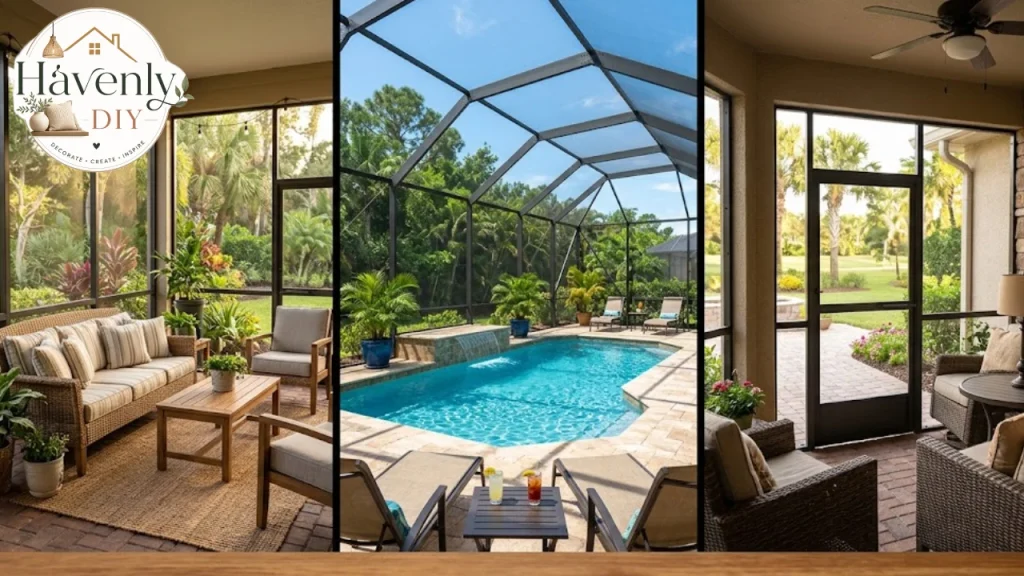
Lanai, Screened Porch or Pool Cage?
The terms overlap. Here’s how they usually differ:
| Space | What it is | Typical roof | Typical use |
|---|---|---|---|
| Screened lanai | A roofed outdoor room attached to the house | Solid roof, often part of the house | Dining, lounging |
| Screened porch | A covered porch with screened openings | House roof or its own roof | Dining, lounging |
| Pool cage | A tall screened structure over a pool and deck | Screened roof on an aluminum frame | Swimming, pool deck |
Some sources, like LawnStarter, say a screened-in porch and a screened lanai have similar costs. A pool cage is a larger and taller structure, so it usually costs more.
Why Screen a Lanai?
People screen a lanai for four reasons:
Insects. Mosquitoes, flies,s and smaller biters stay outside.
Airflow. A lanai screen lets breezes through, unlike glass.
Shade. Some meshes also cut glare and heat.
Debris and pets. Leaves, pollen,en and wandering animals stay out or in.
A screen is not a wall. It won’t block rain or cold air, and it won’t make the room private at night when lights are on. If you need those, a glass or vinyl enclosure may fit better, though it costs more. LawnStarter lists sunrooms at about 42,500 dollars on average, with a range of 27,000 to 58,000 dollars.
Types of Lanai Screen Enclosures
Most projects fall into one of four types.
Screening an Existing Lanai
The lanai already has a roof and a floor. Installers add framing and screen in the openings.
This is the cheapest path. LawnStarter prices it for a 200-square-foot lanai at an average of about 2,000 dollars, with a typical range of 1,310 to 2,530 dollars.
Rescreening an Existing Enclosure
If you already have a screen enclosure, you replace torn or faded mesh in the frame. Breaking AC News, in an article published May 8, 2026, puts rescreening at 2,000 to 8,000 dollars, depending on size and screen type.
Building a New Lanai
Here you build the porch, roof, and screen together. LawnStarter’s average for a new 200-square-foot lanai including the porch is about 16,400 dollars, with a range of 6,110 to 26,530 dollars.
Pool Cages
A pool cage encloses a pool and its deck with a tall aluminum frame. Breaking AC News puts a standard new Florida pool enclosure at 12,000 to 30,000 dollars, and large or two-story versions at 40,000 to 70,000 dollars or more.
That’s a different job from screening a patio, so don’t compare the quotes directly.
Which Type Fits Your Home?
Look at what you already have:
A roofed, floored lanai or porch points to screening only.
A torn or sagging enclosure points to rescreening.
A bare patio points to a new lanai, which is a home addition. Our guide to home additions covers the planning and permit side.
A single-story layout often suits a lanai well. If you own a ranch-style home, the rear patio is a natural place to add one, and if your house has a warm Mediterranean look, our Spanish-style homes guide shows how outdoor rooms fit that architecture.
Lanai Screen Mesh Types
The mesh is the part you touch and look through every day. Every option trades strength against visibility, cost, and corrosion, as Metro Screenworks puts it: which do you need more, durability or visibility?
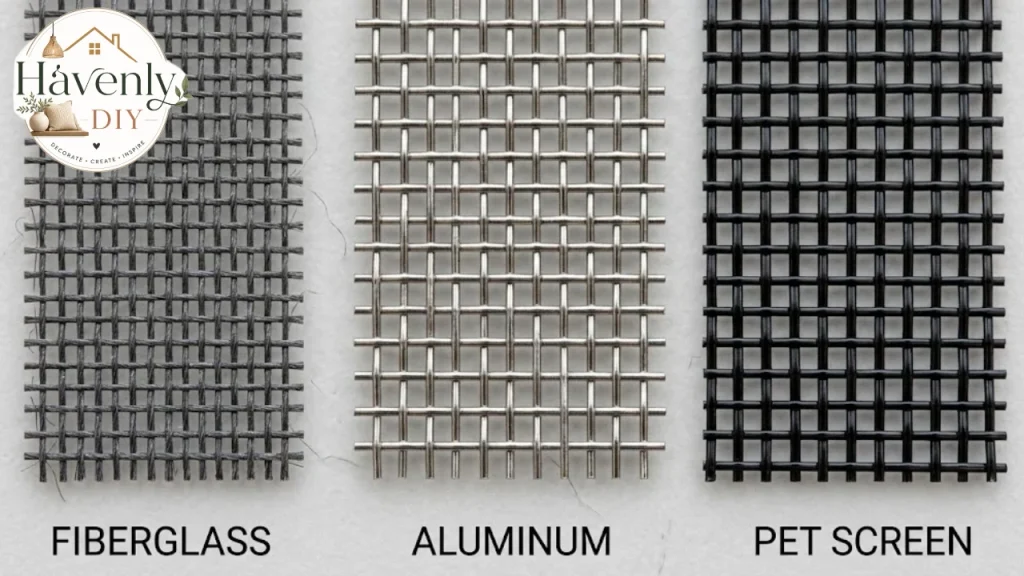
| Mesh | Strength | Visibility | Best for | Watch for |
|---|---|---|---|---|
| Fiberglass | Lower | Good | Budget jobs, humid areas | Stretches and tears |
| Aluminum | Higher | Good (dark colors best) | Wind-prone areas | Corrodes in salty air |
| Pet screen | About 7 times fiberglass | Reduced | Doors and pet areas | Less see-through |
| No-see-um | Varies | Slightly reduced | Pools, porches, patios | Less airflow |
| Solar screen | Varies | Reduced | Sun and heat | Darker view |
| Stainless steel | Highest | Lower | Extreme weather | Highest price |
Choosing Mesh by Situation
Choose the mesh for your lanai screen by situation, not by price alone:
| Situation | Suggested mesh | Why |
|---|---|---|
| Dogs or cats use the lanai | Pet screen on lower panels | About 7 times stronger than fiberglass, per Metro Screenworks |
| Small biting bugs near water | No-see-um mesh | Tight weave suited to pool, porch and patio enclosures |
| Hot, sunny west wall | Solar screen, 80 percent | Blocks 80 percent of sun and UV |
| Tight budget, calm area | Fiberglass | Lowest cost and good visibility |
| Windy, storm-prone area | Aluminum | More resistant to tearing, per AHS Carolinas |
Mixed setups are possible. An installer can put pet screen low, standard mesh high and solar mesh on the sunniest side.
Fiberglass
Fiberglass is the budget choice. AHS Carolinas says it resists corrosion, dents less, and suits humid and coastal areas, with good visibility and airflow.
The downside is strength. It stretches and tears more easily, so it’s a poor match where pets or kids lean on it. Metro Screenworks says fiberglass isn’t strong enough for sliding doors or porch enclosures.
The two sources differ on how far to trust it, so match it to the traffic your screen gets.
Aluminum
Aluminum resists tearing and handles impacts better than fiberglass, according to AHS Carolinas, which calls it a good fit for storm-prone and high-wind areas. Metro Screenworks says it stays tight and is easy to clean, and that charcoal or black offers the best visibility.
The catch is that aluminum can corrode in salty coastal air, and it costs more than fiberglass.
Pet Screen
Pet screen is vinyl-coated polyester. Metro Screenworks says it’s about 7 times stronger than fiberglass and weather resistant, and that its strength reduces visibility, so it’s usually used in doors and enclosures instead of window screens.
It earns its place on lower panels and screen doors where claws and paws hit hardest.
No-See-Um Mesh
A tight weave keeps tiny biting bugs out. Metro Screenworks says it suits pool, porch and patio enclosures. AHS Carolinas notes that fine mesh slightly reduces visibility and airflow.
If you live near water, where small biters are a problem, this is the mesh to ask about.
Solar Screen
Solar screens block part of the sun’s light and heat. Metro Screenworks lists three common ratings:
| Rating | Sun and UV blocked | Openness | Note |
|---|---|---|---|
| 65% | 65 percent | About 32 percent | 20 by 30 mesh count |
| 80% | 80 percent | About 25 percent | Pet-resistant |
| 90% | 90 percent | About 10 percent | Pet-resistant |
A higher rating gives more shade and less view. Many owners use solar mesh only on the sunniest side.
Stainless Steel
Stainless steel offers top resistance to corrosion, tears, and impacts, according to AHS Carolinas, but it has the highest price and cuts visibility and airflow more than the others. Metro Screenworks calls the 0.23 stainless option the most weather- and pet-resistant.
What the Mesh Itself Costs
LawnStarter lists material costs per square foot:
| Material | Cost per sq ft (USD) |
|---|---|
| Fiberglass | 0.15 |
| Aluminum | 0.30 |
| Polyester | 0.60 |
| Stainless steel | 1.00 |
| Brass | 6.00 |
Mesh is a small slice of the total. On a 200-square-foot lanai, the difference between fiberglass and stainless is under 200 dollars in material. Labor and framing drive the bill, so pick mesh for how you’ll use the space.
Wind, Weather and Frames
A screen is a sail. In a storm, the frame and anchors matter as much as the mesh.
Breaking AC News lists aluminum frame quality and finish, roof style, height, and wind-load requirements among the main cost drivers. It says coastal and high-wind-zone homes may need stronger framing, deeper footers, special anchors and engineered plans, which raises cost.
Ask any contractor how the frame is anchored and what wind rating it was engineered for. A cheap quote that skips this is not a bargain.
Permits and Rules
Permits are local, so treat this section as an example.
A lanai screen enclosure often counts as a structure, and many places require a permit. Breaking AC News says most new pool enclosures in Florida require permits, and that the process may include site plans, engineering drawings, wind-load calculations, inspections, and fees.
One County’s Checklist
Hillsborough County, Florida, publishes a checklist for residential screen enclosures, last modified May 14, 2025. It’s one county’s rule, not a national one, but it shows what a permit can involve:
An online application for a residential miscellaneous building permit.
A recorded Notice of Commencement, required before the first inspection.
A scaled site plan showing setbacks to each property line, plus easements and wetlands.
Building plans that follow the current Florida Building Code, signed and sealed by a Florida-registered architect or engineer.
The structure’s risk category on the plans.
Extra compliance for projects in a Special Flood Hazard Area.
The page doesn’t list fees, wind-load values, or setback distances. LawnStarter estimates a permit at about 200 dollars, possibly more depending on location.
Before You Order
Call your building department. Ask whether your project needs a permit, whether a rescreen of an existing frame counts, and what wind rating they require.
Also check homeowners association rules, which often control screen color, frame color,r and height. A denied HOA request can cost more than the permit.
How Much Does a Lanai Screen Cost?
The answer for a lanai screen depends on the job. These are published estimates, and your quote will differ.
| Job | Typical cost (USD) | Source |
|---|---|---|
| Screening an existing 200 sq ft lanai | 1,310 to 2,530 (average 2,000) | LawnStarter |
| Rescreening an existing enclosure | 2,000 to 8,000 | Breaking AC News (May 8, 2026) |
| Standard new pool enclosure, Florida | 12,000 to 30,000 | Breaking AC News |
| New 200 sq ft lanai with porch | 6,110 to 26,530 (average 16,400) | LawnStarter |
| Two-story or panoramic enclosure | 40,000 to 70,000 or more | Breaking AC News |
Cost per Square Foot
LawnStarter puts a screen-only lanai at an average of 10 dollars per square foot, with a typical range of 6.50 to 13 dollars. It splits that into 3.05 to 4.90 dollars for materials and 5.35 to 7.55 dollars for labor.
Breaking AC News gives 10 to 20 dollars per square foot for a basic enclosure, 20 to 35 for a standard pool cage,ge and 35 to 60 or more for custom or panoramic designs. The overlap at 10 dollars shows the two sources agree on the low end.
Screen-Only Cost by Size
LawnStarter lists these averages for screening a lanai that already has a roof and floor:
| Size (sq ft) | Average (USD) | Typical range (USD) |
|---|---|---|
| 80 | 800 | 520 to 1,040 |
| 144 | 1,440 | 940 to 1,870 |
| 200 | 2,000 | 1,310 to 2,530 |
| 224 | 2,240 | 1,340 to 2,900 |
| 300 | 3,000 | 1,950 to 3,900 |
| 350 | 3,500 | 2,750 to 4,550 |
| 400 | 4,000 | 2,400 to 5,200 |
A Worked Example
Say your lanai measures 10 by 25 feet, or 250 square feet, and already has a roof and slab.
Rate: 250 square feet at 6.50 to 13 dollars equals 1,625 to 3,250 dollars.
Add a screen door, about 300 dollars on average per LawnStarter, and a permit of about 200 dollars.
Total: about 2,125 to 3,750 dollars.
That lines up with LawnStarter’s table, which has 224 square feet at 1,340 to 2,900 dollars and 300 square feet at 1,950 to 3,900 dollars. The arithmetic is mine, not a published quote.
Extras That Add Up
LawnStarter lists other items:
Screen door. About 300 dollars on average, up to 1,500 for high-end.
Mesh insect door. About 15 dollars.
Permit. About 200 dollars, possibly more.
Porch repair. About 2,365 dollars on average, if the slab or frame needs work.
Solar mesh, pet panels, stronger framing, and engineered plans all raise the total. Breaking AC News also names roof style and height as drivers.
Why Quotes Differ
Every source above calls its figures broad estimates. Size, height, roof style, frame quality, mesh choice, wind rating,g and local labor rates all move the number.
Get at least three on-site quotes from licensed contractors. Ask each one to list mesh type, frame material, anchoring, permit handling, and warranty.
Planning a Lanai Screen Project
Work through these steps in order:
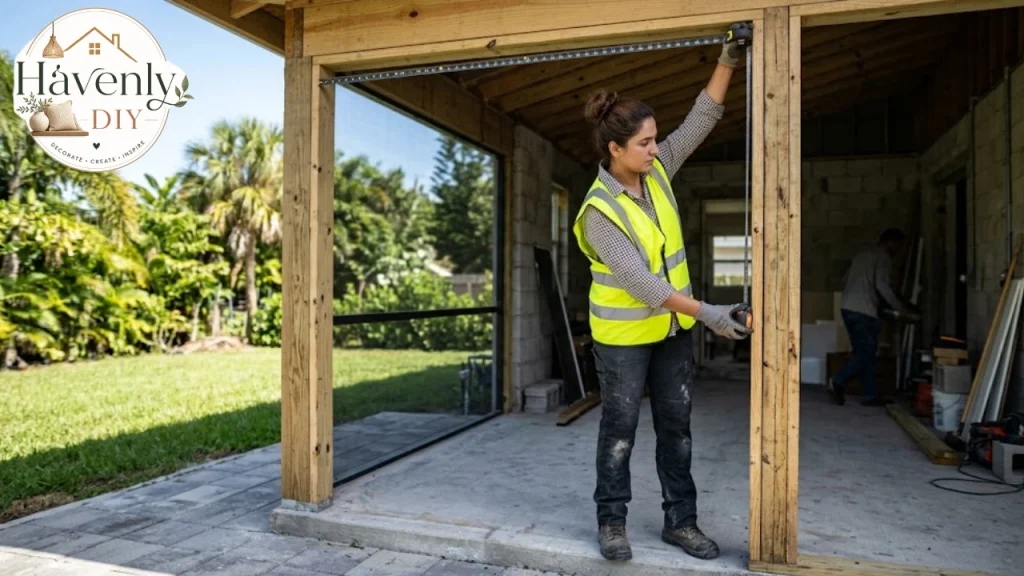
Measure. Record the width and height of each opening, then total the square feet.
Decide the job. Screening, rescreening, or building new each has a different price range.
Pick the mesh. Match strength, visibility, and sun control to how you’ll use the space.
Check the rules. Call the building department and read any HOA rules.
Collect quotes. Ask for three written, on-site quotes with the same scope.
Schedule the work. Book installation well ahead of peak storm season where you can.
A lanai screen project goes smoothly when you settle the job type and the mesh before you ask for prices.
DIY or Hire a Pro?
DIY saves real money on a simple job. LawnStarter estimates savings of 1,070 to 1,510 dollars on a 200-square-foot screening project, with tools costing about 100 dollars or less.
When DIY Makes Sense
- You’re replacing mesh in an existing, sound frame.
- The panels are small and at ground level.
- You’re comfortable measuring and working with spline and a rolling tool.
When to Hire
- The job needs new framing, a roof, or a slab.
- The structure is tall or exposed to high wind.
- A permit with sealed plans is required, as in the Hillsborough County checklist.
If the work needs engineered drawings, a licensed contractor is the practical choice, because the plans have to be signed and sealed anyway.
Caring for a Lanai Screen
A little care stretches the life of any mesh. These are general maintenance habits, not figures from the sources above.
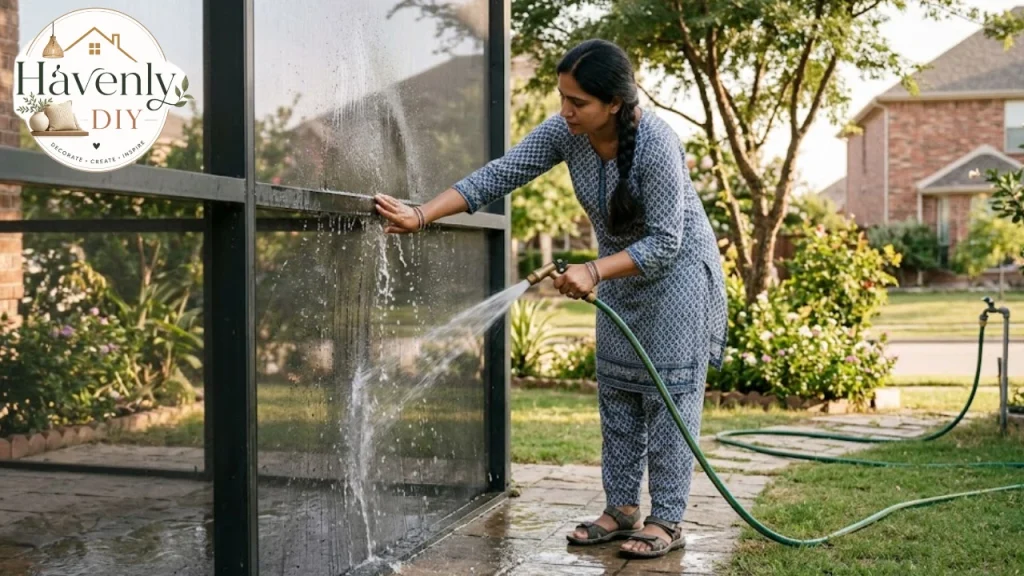
Rinse regularly. Pollen, dust,t and salt build up. A garden hose and a soft brush with mild soap do the job.
Check for tears. Patch small holes before they grow.
Inspect the frame. Look for loose fasteners, bent members, and corrosion, especially near the coast.
Trim branches. Limbs that rub the screen wear it down.
Plan for storms. Ask your installer what to do before a major wind event.
If your screen sags or fades, it may be time to rescreen. Costs for that job are in the table above.
Designing and Furnishing Your Lanai
Once the screen is up, the lanai becomes a room. Treat it like one.
Choose Furniture That Fits the Climate
Pick outdoor-rated pieces that handle humidity and shade. Our best home furnishings roundup is a good place to start when you’re comparing seating and tables.
Add Light and Airflow
A ceiling fan pushes air and helps with bugs. Layer in warm lights, such as string lights or sconces, so the lanai feels welcoming after dark.
Use Color and Texture
Light, breathable fabrics keep a lanai feeling airy. A few natural textures, like rattan or jute, add warmth.
Bring in a Cooking Corner
Some owners add a small serving area for drinks and snacks. If you like a breezy, coastal look, our coastal kitchen guide has palette and material ideas you can borrow.
Common Lanai Screen Mistakes
Choosing mesh on price alone. Fiberglass tears where pets and kids lean.
Ignoring the frame. A strong mesh in a weak frame still fails in a storm.
Skipping the permit check. Many places require permits for screen enclosures.
Forgetting HOA rules. Color and height limits can force a redo.
Comparing unlike quotes. Rescreening, screening and building new are different jobs.
Over-darkening the view. A 90 percent solar mesh blocks much of the light and the view.
Ignoring salt air. Aluminum can corrode near the coast, so ask about coatings.
FAQs:
How much does it cost to screen in a lanai?
LawnStarter puts screening an existing 200 square foot lanai at an average of about 2,000 dollars, with a typical range of 1,310 to 2,530 dollars. A new lanai with a porch averages about 16,400 dollars.
What is the best screen material for a lanai?
It depends on use. Fiberglass is the budget pick, aluminum is stronger, pet screen suits doors and heavy use, and no-see-um mesh suits areas with small biting bugs.
Is pet screen worth it on a lanai?
For doors and lower panels, yes. Metro Screenworks says pet screen is about 7 times stronger than fiberglass, though its strength reduces visibility.
How much does it cost to rescreen a lanai or pool cage?
Breaking AC News, published May 8, 2026, puts rescreening an existing enclosure at 2,000 to 8,000 dollars, depending on size and screen type.
Do I need a permit to screen a lanai?
Often yes, but rules are local. Hillsborough County, Florida, requires a permit, a recorded Notice of Commencement,t and sealed plans for residential screen enclosures. Ask your own building department.
Can I install a lanai screen myself?
For replacing mesh in a sound frame, many owners can. LawnStarter estimates DIY savings of 1,070 to 1,510 dollars on a 200-square-foot job. New framing, tall structures, and permitted work are better left to licensed contractors.
What does a solar screen do?
It blocks part of the sun. Metro Screenworks lists 65, 80, and 90 percent ratings, with the higher ratings blocking more light and leaving less openness for the view.
How long does a lanai screen last?
I couldn’t find a sourced lifespan, so I won’t give a number. Mesh type, sun, salt air, and storms all matter. Ask your installer for the warranty terms in writing.