

Wallpaper can completely change a bathroom. A plain room with white tile and a basic vanity can suddenly feel warm, dramatic, playful, traditional, or surprisingly luxurious. But there is a catch. A bathroom is not just another room with four walls.
Steam, condensation, splashes, cleaning products, temperature changes, and poor ventilation can expose a wall covering to conditions it was never designed to handle. So the real question isn’t simply, “Can I use wallpaper in a bathroom?” It is:
Which wallpaper, on which wall, in which bathroom, and under what conditions? That’s the distinction that prevents a beautiful makeover from turning into peeling seams and bubbled wallpaper.
Can You Use Wallpaper in a Bathroom?
Yes. Modern wallcoverings make bathroom wallpaper much more practical than it once was, particularly in powder rooms and on walls that don’t get direct water exposure. Vinyl, vinyl-coated, certain non-woven products, performance wallcoverings, and some peel-and-stick products can tolerate everyday bathroom humidity.
This is true when they are installed according to the manufacturer’s instructions. Current guidance from Sherwin-Williams, Duravit, Martha Stewart, and Architectural Digest all point toward choosing moisture-appropriate materials rather than treating every wallpaper as interchangeable.
The important distinction is this: humidity-resistant does not automatically mean waterproof. A wall behind a vanity is very different from the inside of a shower enclosure. If water regularly hits the wall, wallpaper is usually the wrong finish. Tile, stone, solid-surface panels, or another purpose-built wet-area material makes more sense there.
The 30-Second Bathroom Wallpaper Test
Before falling in love with a pattern, look at the room itself. Ask five questions:
- Does the bathroom have a working exhaust fan or good natural ventilation?
- Does the proposed wallpaper wall receive direct shower or bath spray?
- Does the wall already have damp, mold, staining, or bubbling paint?
- Is the wall smooth, sound, clean, and completely dry?
- Does the wallpaper manufacturer specifically allow the product in humid areas?
If the answers are mostly yes, you probably have a workable project. If the wall is repeatedly wet or already has a moisture problem, stop there. Wallpaper can cover a cosmetic problem, but it cannot repair moisture coming through a wall.
That last point is easy to overlook. Experts interviewed by Homebuilding specifically warn against wallpapering over a wall with an existing damp problem because moisture trapped behind the covering can create a much bigger issue.
The Best Wallpaper Materials for Bathrooms
There isn’t one universal “best” wallpaper. The right choice depends on how much moisture the room experiences.
Vinyl wallpaper
Vinyl is one of the most practical choices for bathrooms because its surface is designed to resist moisture and tolerate cleaning better than ordinary paper wallcovering.
For a busy family bathroom, look for a product specifically described by its manufacturer as suitable for humid or bathroom conditions rather than assuming every wallpaper containing vinyl is automatically appropriate. A good vinyl surface can be especially useful around vanity areas where toothpaste, hairspray, and everyday splashes are more likely.
Vinyl-coated wallpaper
Vinyl-coated products give a decorative surface additional protection. They can be a good middle ground when you want the look of a traditional printed wallcovering but need more resistance to everyday bathroom conditions.
Again, check the actual product specifications. “Vinyl-coated” tells you something about construction; it does not permit you to put the paper inside a shower.
Non-woven wallpaper
Non-woven wallpaper uses a synthetic fiber-based backing rather than relying entirely on traditional paper construction. It is dimensionally stable and can be easier to handle during installation.
Some non-woven products are perfectly suitable for bathrooms, while others are not. The manufacturer’s moisture and cleaning instructions matter more than the word “non-woven” by itself.
Peel-and-stick wallpaper
Peel-and-stick is attractive for renters, quick updates, and people who don’t want to commit to paste. It can work well in powder rooms and low-splash bathroom areas, provided the specific product is rated for the conditions, and the wall is properly prepared.
The weak point is often the adhesive rather than the printed surface. Steam and repeated humidity can test an adhesive bond, especially on a poorly prepared wall. That’s why “peel-and-stick” shouldn’t be treated as a magic category of waterproof wallpaper.
Commercial-grade wallpaper
Commercial-grade wallcoverings can make sense in bathrooms that experience heavier use. Architectural Digest’s current recommendations include commercial-use products among its bathroom selections, highlighting durability and cleanability as useful qualities for splash-prone spaces.
They may cost more, but durability can matter more than the initial price when removing and reinstalling wallpaper would be a miserable job.
Waterproof vs. Water-Resistant: Don’t Confuse the Two
This is one of the most useful distinctions to understand before shopping. Water-resistant generally means the surface can tolerate some moisture without immediately absorbing it. Waterproof implies a much higher level of resistance, but even that term should be checked against the manufacturer’s intended application.
A wallpaper that survives a damp cloth is not necessarily suitable for a wall that gets blasted by a shower every morning. The same problem exists with the word “washable.” Washable does not automatically mean waterproof.
Some washable wallpapers can handle gentle cleaning but are still inappropriate for constant moisture exposure. Practical bathroom guidance from Angi and Duravit makes this distinction clear. When shopping, look beyond the marketing headline and check:
- material construction
- washability rating
- moisture suitability
- adhesive requirements
- recommended rooms
- installation instructions
- cleaning instructions
- whether a sealant is permitted
That small amount of homework can save a surprisingly large amount of money.
Where Wallpaper Works Best in a Bathroom
The safest and most forgiving locations are usually walls away from direct water.
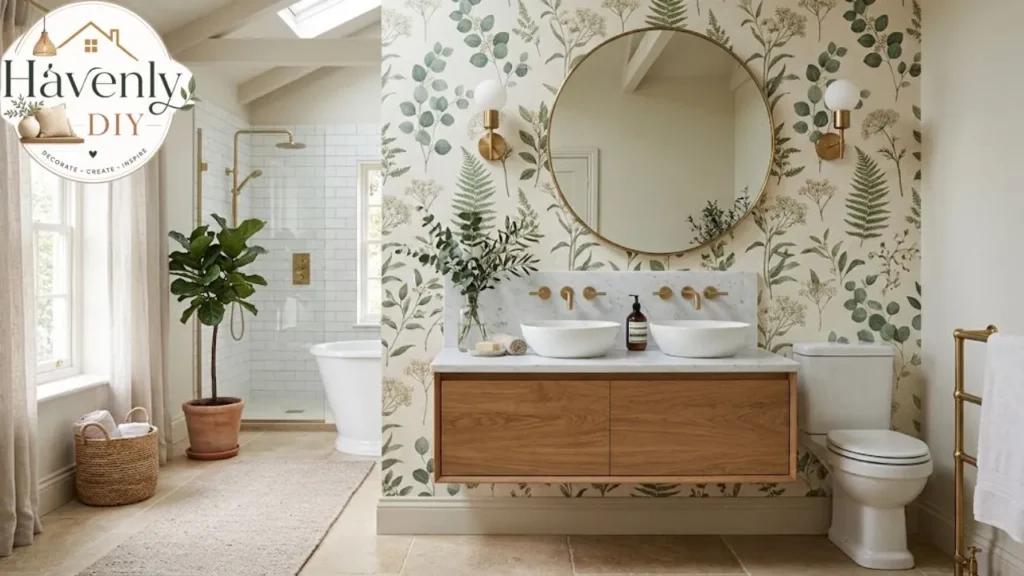
Behind the vanity
This is one of the most visually rewarding choices. A wallpapered vanity wall creates a backdrop for the mirror, sconces, and hardware without putting the wall directly inside the shower’s splash zone.
Behind the toilet
A small wall behind the toilet can become a natural feature wall. This is particularly effective in compact bathrooms because the wallpaper adds visual interest without competing with a large shower enclosure.
Above wainscoting or beadboard
This is one of the smartest combinations for homeowners who love bold patterns but don’t want every wall covered. The lower section provides a durable architectural base while the wallpaper creates the decorative layer above it.
B&Q and House Beautiful both highlight combinations involving wallpaper, paneling, and wainscoting as ways to balance pattern and practicality.
A single accent wall
If you’re nervous about commitment, start here. A single wall can give you the visual effect without requiring the same amount of material, installation time, or design confidence.
Where Wallpaper Should Not Go
Avoid treating wallpaper like tile. The inside of a shower enclosure is an obvious no-go for ordinary decorative wallpaper. The same principle applies to walls that receive repeated direct spray from a showerhead or handheld sprayer.
Also think twice about a wall that stays wet for long periods after every shower. And never use wallpaper to hide an unresolved damp wall. If moisture is coming from behind the wall, the wallpaper is only covering the evidence. That’s not a decoration problem. It’s a building problem.
Powder Room vs. Full Bathroom: A Major Difference
A powder room is almost the dream environment for wallpaper. There is usually no shower. There is less steam. There is less direct water exposure. And because the room is often small, you can use a dramatic pattern without buying huge quantities.
That’s why designers so often use bold wallpaper in powder rooms. House Beautiful describes these smaller rooms as “jewel boxes,” where homeowners can take more risks with color and pattern. A full bathroom requires more discipline.
You don’t have to abandon wallpaper. You simply need to think about moisture exposure wall by wall. A vanity wall may be perfectly reasonable while the wall immediately beside the shower needs tile or another moisture-tolerant finish. That combination often produces a better bathroom anyway.
How to Choose a Wallpaper Pattern
Once the practical side is sorted, the fun part begins.
Large-scale florals
Large flowers can look surprisingly sophisticated in a small bathroom. Don’t automatically assume that tiny patterns are better for small spaces. Architectural Digest specifically notes that large-scale prints can make a stronger impact in compact rooms.
Botanical prints
Leaves, vines, and botanical illustrations work especially well with natural wood, brass, stone, rattan, and warm white finishes. Green wallpaper paired with warm wood can make a bathroom feel less clinical.
Stripes
Vertical stripes can emphasize height. A narrow vertical pattern is especially useful when the bathroom wallpaper has a low ceiling, and you want to strengthen the vertical lines.
Toile
Toile works beautifully when you want a traditional or collected look. Pair it with simple fixtures rather than filling every surface with competing patterns.
Murals
A mural can turn a small bathroom into an immersive room rather than simply a room with decorated walls. Landscape murals, botanical scenes and painterly patterns are particularly effective because they create visual depth.
Moody wallpaper
Dark blue, charcoal, forest green and near-black patterns can work beautifully in bathrooms. The old idea that a small bathroom must always be white is too simplistic. A small room can actually benefit from being visually enveloping.
House Beautiful’s current examples include dark, monochromatic, and highly patterned bathroom treatments rather than relying exclusively on pale colors.
How to Make a Small Bathroom Look Better With Wallpaper
Don’t choose wallpaper based solely on whether the room is small. Instead, look at the ceiling height, natural light, fixtures, and pattern scale. If the ceiling is low, vertical movement can help.
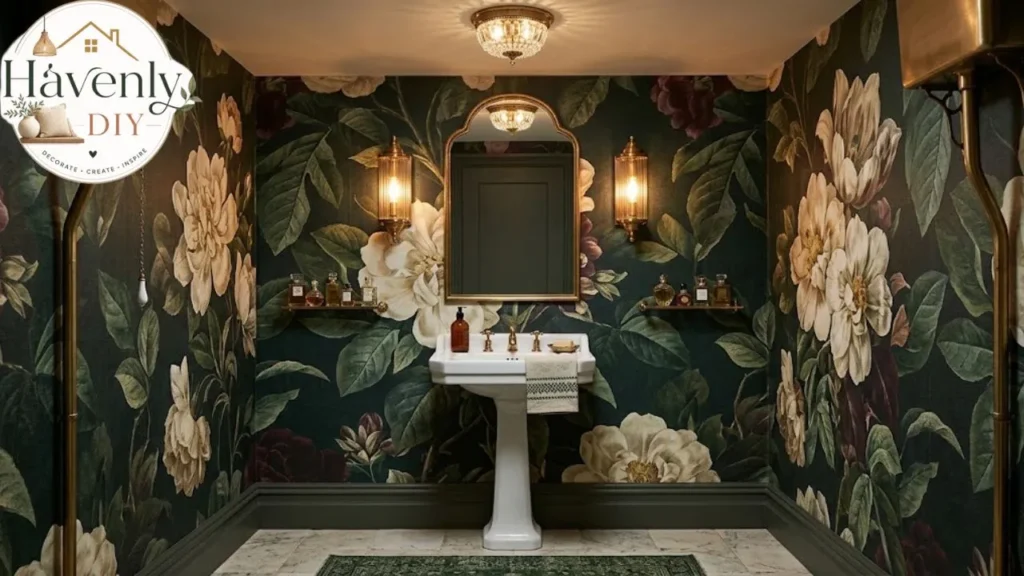
If the bathroom is windowless, a wallpaper with depth and a carefully coordinated lighting scheme can make the room feel intentional rather than cramped. If the vanity and flooring are already visually busy, use a quieter wallpaper.
If the bathroom is mostly white, you have more freedom to make the wallcovering the star. And if you fall in love with a bold pattern, don’t automatically talk yourself out of it because someone said small bathrooms need small prints. The better question is whether the pattern works with everything else in the room.
Wallpaper With Tile and Wainscoting
One of the most practical design approaches is not choosing between wallpaper and tile. Use both. For example:
Lower wall: white or colored tile
Upper wall: patterned wallpaper
Trim: painted woodwork
Vanity: natural oak
Hardware: aged brass
Now the wallpaper isn’t being asked to perform the job of a wet-area finish. It’s doing what wallpaper does best: creating atmosphere. This approach also gives you a visual stopping point, which can make a strong pattern feel more intentional.
How to Install Bathroom Wallpaper Properly
Good wallpaper can fail because of bad preparation. The wall should be:
- clean
- smooth
- dry
- stable
- free from active damp
- properly primed where required
Sherwin-Williams’ installation guidance begins with cleaning the wall, measuring carefully, applying adhesive correctly, and smoothing the paper to remove bubbles and wrinkles.
Fix the wall first
Don’t wallpaper over peeling paint, active mold, damp patches, or unstable surfaces. Repair the underlying problem before decorating.
Prime when the product requires it
Primer can help create a consistent surface and make future removal easier. For peel-and-stick wallpaper, a smooth, clean, properly prepared wall is especially important.
Measure twice
Bathrooms have awkward interruptions:
- mirrors
- outlets
- switches
- medicine cabinets
- windows
- vanities
- toilets
Plan the layout before cutting.
Pay attention to pattern matching
This is where inexperienced DIY installations often go wrong. A beautiful wallpaper can look cheap if the repeat doesn’t line up correctly.
Treat seams carefully
The seams are often where a bathroom installation reveals its weaknesses. Moisture that reaches an inadequately bonded edge can contribute to lifting. Follow the wallpaper manufacturer’s adhesive and seam-treatment instructions rather than adding random products in the hope of making the paper “more waterproof.”
Let it cure
Don’t immediately return to normal shower-and-steam conditions after installation. Sherwin-Williams recommends avoiding normal bathroom use for 24 to 48 hours while the installation dries. Always follow the specific product instructions if they differ.
Ventilation Is Part of the Wallpaper Installation
People often spend hours choosing the wallpaper and almost no time thinking about what happens to the moisture after a shower. That is backwards. A good exhaust fan, an open window where appropriate, and sensible moisture management can make the environment much friendlier to a wallcovering.
Use the exhaust fan during and after showers according to the bathroom’s needs. Don’t leave damp towels piled against walls. Wipe obvious standing water.
If the room routinely stays steamy long after someone showers, investigate the ventilation problem before blaming the wallpaper. A wallpaper surface cannot compensate for a bathroom that never properly dries.
Why Bathroom Wallpaper Peels
If wallpaper starts lifting, don’t automatically assume the product was defective. Common causes include:
Excess moisture
Repeated humidity stresses adhesives and seams.
Direct splashing
A wall that gets wet every day is a very different environment from one that merely experiences humid air.
Poor wall preparation
Dust, grease, old unstable paint, and uneven surfaces interfere with adhesion.
Damp behind the wall
This is the most serious possibility. If moisture is coming through the wall, replacing wallpaper without fixing the source is unlikely to solve anything.
Incorrect adhesive
Not every adhesive is suitable for every wallcovering. Use what the manufacturer specifies.
Poor installation
Uneven adhesive coverage, badly aligned seams, and trapped air can all contribute to future problems.
How to Clean Bathroom Wallpaper
Cleaning should be gentle unless the manufacturer explicitly says the surface can tolerate more aggressive cleaning. Start with the product’s care instructions. For routine cleaning, a soft damp cloth may be enough. Avoid soaking the wallpaper.
Avoid abrasive cleaners. Don’t scrub a delicate printed surface simply because the bathroom needs cleaning. And remember that cleaning requirements are another reason to choose the right material before installation. A gorgeous wallpaper that cannot tolerate the way your household actually uses the bathroom isn’t a good choice.
Should You Use Peel-and-Stick Wallpaper in a Bathroom?
Sometimes. It’s particularly appealing for:
- powder rooms
- rental bathrooms
- vanity walls
- temporary makeovers
- low-splash areas
The surface underneath matters enormously. Peel-and-stick performs best on smooth, clean, and fully dry walls. Heavy texture, poorly cured paint, and persistent humidity can create adhesion problems.
Some current manufacturers specifically state that their peel-and-stick products can handle everyday bathroom humidity while still advising against direct water exposure. So don’t buy based on the words “peel-and-stick” alone. Read the manufacturer’s bathroom-use guidance for the exact material.
Should You Wallpaper the Bathroom Ceiling?
A bathroom ceiling can be a fantastic place for wallpaper, particularly in a small powder room. It draws the eye upward and creates an enclosed, decorative effect.
But the ceiling still experiences humidity. Use a product appropriate for the room and make sure ventilation is good. A dramatic ceiling can be especially effective when the walls are kept relatively simple.
When Bathroom Wallpaper Is a Bad Idea
Wallpaper isn’t the right answer for every bathroom. Choose another finish if:
- the wall has unresolved damp
- the wall receives constant direct water
- ventilation is chronically poor
- the substrate is unstable
- you cannot meet the product’s installation requirements
- the manufacturer doesn’t approve the material for the environment
- you want a maintenance-free wet-area surface
There’s nothing wrong with choosing tile. A good bathroom design isn’t the one that uses the trendiest material. It’s the one that survives real life.
12 Bathroom Wallpaper Ideas Worth Stealing
If you’re ready for the design side, these combinations are particularly versatile:
- Green botanical wallpaper + warm wood vanity
- Blue-and-white stripe + brass hardware
- Large floral print + simple white tile
- Moody mural + soft lighting
- Toile + traditional mirror
- Tonal geometric wallpaper + modern black fixtures
- Wallpaper above white beadboard
- Patterned wallpaper + matching painted trim
- Faux grasscloth + natural stone
- Small-scale vintage print + antique-style brass
- Bold ceiling wallpaper + quiet walls
- One dramatic accent wall + restrained tile elsewhere
The trick isn’t copying a photograph exactly.
It’s understanding the relationship between the wallpaper and everything around it.
The Best Bathroom Wallpaper Is the One That Fits the Room
The prettiest roll in the store isn’t necessarily the best choice. If you have a powder room, you have enormous creative freedom. If you have a full bathroom wallpaper, choose your walls strategically. If you have a shower bathroom, keep decorative wallcoverings away from direct spray.
If you have poor ventilation, solve that first. If your wall is damp, stop and investigate the moisture before decorating. And if you’re torn between a quiet pattern and the dramatic one you really love, remember that a bathroom is often one of the safest places in a home to take a design risk.
Current designers continue to use bathrooms and powder rooms for bold florals, immersive murals, dark patterns, textured surfaces, and unexpected color precisely because the smaller footprint makes experimentation easier. The goal isn’t to make wallpaper behave like tile.
The goal is to put the right wallcovering in the right part of the bathroom, then let it do what it does best: make an ordinary room feel unmistakably yours.
Frequently Asked Questions
Can you put wallpaper in a bathroom?
Yes, provided the wallpaper is appropriate for humid conditions, the wall is sound and dry, ventilation is adequate, and the wallpaper is kept away from constant direct water exposure.
What is the best type of wallpaper for a bathroom?
Vinyl, vinyl-coated, appropriate non-woven, and certain commercial-grade wallcoverings are common choices. The manufacturer’s bathroom-use instructions matter more than the material name alone.
Is peel-and-stick wallpaper good for bathrooms?
It can work particularly well in powder rooms and low-splash areas. Check that the exact product is approved for bathroom humidity and install it on a smooth, clean, dry wall.
Can you use wallpaper in a bathroom with a shower?
Yes, but keep the wallpaper away from direct shower spray. A bathroom containing a shower isn’t automatically unsuitable; the location of the wallpaper within the room matters.
Is bathroom wallpaper waterproof?
Not necessarily. Many products are moisture-resistant or washable rather than genuinely waterproof. Never assume that a “washable” label means the wallpaper can tolerate constant direct water.
Can wallpaper go behind a bathroom sink?
Yes. The wall behind a vanity is generally a more suitable location than a wall directly exposed to shower spray, provided the wallpaper is appropriate for the room.
Why does bathroom wallpaper peel?
Common causes include excessive moisture, direct water exposure, poor ventilation, inadequate wall preparation, incompatible adhesive, damp behind the wall, or poor installation.
Can you wallpaper a small bathroom?
Absolutely. Small bathrooms and powder rooms can be excellent places for bold wallpaper because they require less material and can accommodate stronger patterns without overwhelming the rest of the home.