

A beautiful bedroom doesn’t have to announce itself. Sometimes the most successful room is the one that makes you breathe a little slower when you walk into it. There is less furniture, but not less comfort. Less decoration, but somehow more character. The light is softer.
The wood feels warm. The bed sits lower. Nothing seems to be fighting for your attention. That is the appeal behind a Japanese bedroom. But there is a catch: copying a few recognizable Japanese objects does not automatically create a Japanese room.
A bamboo plant, paper lantern, and beige bedding can just as easily produce a themed bedroom. The better approach is to borrow the underlying ideas: restraint, natural materials, thoughtful proportions, flexible space, filtered light, and a genuine respect for what you choose to leave empty.
Traditional Japanese rooms, known as washitsu, are associated with tatami flooring and may also include features such as shoji screens, fusuma sliding doors, an oshiire storage closet, and a tokonoma alcove. Modern homes don’t have to reproduce all of those elements.
You can create the same sense of calm with a low wooden bed, warm lighting, linen bedding, concealed storage, and a room that finally offers your eyes somewhere to rest.
What Actually Makes a Bedroom Japanese?
The easiest mistake is to treat Japanese design as a shopping list. Tatami. Futon. Bonsai. Paper lantern. Done. Real Japanese interiors are more interesting than that. One of the most useful ideas to borrow is ma, often described as meaningful or intentional space between things. The empty area isn’t unfinished. It gives the objects around it room to be noticed.
This changes the way you arrange a bedroom. Instead of asking, “What can I put on this empty wall?” ask, “Does this wall need anything?” Instead of buying two nightstands because bedrooms normally have two, ask whether you actually need them.
Instead of pushing furniture into every corner, allow part of the floor to remain visually quiet. Traditional Japanese architecture also demonstrates a strong relationship between interior space, light, air, and the outdoors.
Japanese government material describes how traditional houses used features such as the engawa, deep eaves, fusuma, and shoji to influence airflow, shading, and the connection between the inside and the outside. That is a much richer starting point than “make everything beige.”
Traditional Japanese Bedroom vs Modern Japanese-Inspired Bedroom
These are related, but they aren’t identical. A traditional washitsu has a very specific architectural vocabulary. Tatami is fundamental, and traditional fittings can include shoji, fusuma, tokonoma, and built-in storage. A modern Japanese-inspired bedroom may instead have:
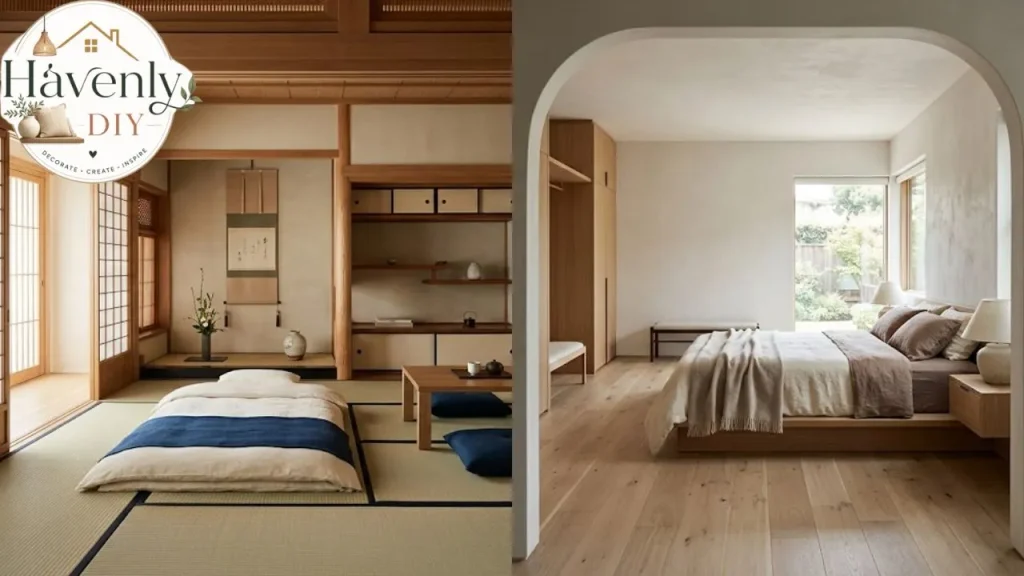
- a wooden platform bed
- ordinary hardwood flooring
- linen bedding
- neutral walls
- concealed storage
- simple ceramics
- warm indirect lighting
- one carefully selected artwork
That’s perfectly reasonable. In fact, for most Western homes, it is probably the better approach. The goal isn’t to create a museum reproduction. It is to create a bedroom influenced by Japanese spatial thinking while still working with the architecture, climate, budget, and habits you actually have.
15 Japanese Bedroom Ideas That Work in Real Homes
Start with a Low Bed
A low platform bed immediately changes the visual weight of a bedroom. You see more wall and floor around it, which can make the room feel calmer and less crowded. Choose a simple frame in oak, walnut, or another natural wood.
Avoid ornate headboards and excessive upholstery if you’re aiming for a restrained look. You don’t need to put the mattress directly on the floor. A low platform gives you the visual effect while providing a more familiar sleeping height.
Try a Shikibuton Only If It Fits Your Lifestyle
A shikibuton is different from the thick Western mattress most people know. Traditionally, Japanese sleeping arrangements can use a shikibuton placed over tatami, with bedding that can be put away when the room needs to serve another purpose.
J-Life’s guide specifically identifies tatami, shikifuton, kakefuton, and buckwheat-hull pillows as components of a traditional Japanese sleep system. The important word is lifestyle. If you enjoy folding bedding, airing it, and keeping the floor clear, a futon system can be wonderful.
If you hate putting your bed away every morning, don’t force yourself into it simply because it looks authentic. A low platform bed can capture much of the visual character with far less daily work.
Let Wood Do More of the Decorating
Japanese-inspired bedrooms rarely need a lot of decorative objects when the materials are doing the work. Warm wood adds:
- color
- texture
- pattern
- warmth
- visual continuity
Use it on the bed frame, nightstand, shelving, or even one architectural feature. Don’t use five different wood tones. Two related finishes are usually enough.
Use a Restrained Color Palette
Think beyond plain white and beige. Good combinations include:
- warm white + oak + charcoal
- cream + walnut + muted green
- stone + pale wood + black
- warm gray + natural oak + clay
- soft beige + dark brown + off-white
Japanese-inspired interiors can handle darker colors beautifully when they are used deliberately. A charcoal wall behind a low wood bed can feel far more sophisticated than painting the entire room bright white.
Create Texture Instead of Adding More Stuff
This is one of the best tricks for avoiding the “empty showroom” problem. Use:
- washed linen
- cotton
- wool
- woven baskets
- matte ceramic
- natural wood
- subtle rugs
- textured plaster
- handmade-looking finishes
Texture gives the eye something to discover without filling the room with objects.
Borrow the Feeling of Shoji Without Faking a Traditional Room
Traditional shoji are wooden frames covered with translucent paper and are used to filter light and provide separation. You don’t need to install authentic shoji doors. In a modern home, consider:
- translucent room dividers
- fluted glass
- timber-framed screens
- sheer curtains
- slim vertical blinds
The principle is filtered privacy rather than decoration for decoration’s sake.
Keep the Center of the Room Quiet
This matters enormously in small bedrooms. Don’t automatically fill the center with a bench, chair, basket, and decorative rug. A clear walking path makes the entire room feel more generous. If the bedroom is tiny, prioritize:
- bed
- lighting
- clothing storage
- circulation
Everything else is optional.
Hide the Things That Make Your Bedroom Look Busy
A calm bedroom can be ruined by six visible charging cables. Use:
- bedside cable management
- closed nightstands
- baskets
- built-in wardrobes
- under-bed drawers
- concealed power strips
The trick isn’t owning nothing. It’s making everyday objects disappear when you’re finished using them.
Choose Lighting That Doesn’t Shout
Overhead ceiling lights are useful, but they shouldn’t be the only light source. Try three layers: Ambient: a warm ceiling or wall fixture. Task: a bedside reading lamp. Accent: a small floor lamp or indirect light washing a wall.
Warm white light around 2700K–3000K is commonly recommended in contemporary Japandi guidance for creating a relaxed evening atmosphere. More importantly, prevent glare. A beautiful lamp pointed directly into your eyes isn’t calming.
Add One Meaningful Natural Element
You don’t need a jungle. One plant can be enough. Consider a restrained plant in a handmade ceramic pot, a branch arrangement, or a small seasonal display.
Traditional Japanese rooms can also use a tokonoma to display carefully selected objects, such as flowers or a hanging scroll. The lesson is selection. Not quantity.
Use Low Storage
Tall furniture can visually dominate a bedroom. If your room allows it, consider:
- low drawers
- low chests
- built-in wardrobes
- under-bed storage
- simple wall shelving
A traditional Japanese storage closet, the oshiire, is specifically associated with storing bedding and other items. Modern storage can follow the same basic principle: let the room look calm because the mess has somewhere sensible to go.
Make the Window Part of the Design
Don’t treat windows as an afterthought. Japanese-inspired rooms benefit from soft transitions between bright daylight and evening darkness. Layer:
- sheer curtains
- simple blinds
- blackout curtains where necessary
The result is softer than leaving a bare window or using heavy curtains alone.
Choose One Strong Piece of Art
A completely blank room can feel sterile. Ten pieces of wall art can feel chaotic. One carefully chosen piece often lands in the sweet spot. Try:
- understated landscape art
- calligraphy-inspired work
- abstract ink artwork
- botanical art
- a handmade textile
- seasonal artwork
Avoid filling the walls with stereotypical Japanese imagery simply because it is “Japanese.”
Let Imperfection Add Character
This is where wabi-sabi becomes useful. The concept has deep roots in Japanese aesthetics and is associated with understated beauty, impermanence, and the appreciation of irregular or weathered things. The Metropolitan Museum of Art discusses the relationship between Zen, simplicity, and wabi-sabi aesthetics. In a bedroom, that could mean:
- wood with visible grain
- handmade pottery
- a slightly irregular ceramic vase
- linen with natural wrinkles
- aged timber
- a woven textile with variation
Your bedroom doesn’t have to look factory-perfect.
Leave Something Unfinished
This may be the hardest idea for decorators. Stop. You don’t have to fill the final shelf. You don’t need something above the bed. You don’t need a second plant. You don’t need another decorative tray. Sometimes the most Japanese-inspired decision you can make is to leave the room alone.
Choosing the Bed: Futon, Shikibuton or Low Platform Bed?
Here’s the practical version.
Choose a futon/shikibuton if:
- you like floor sleeping
- you have good ventilation
- you can maintain and air the bedding
- you want flexible floor space
- you genuinely enjoy the routine
Choose a low platform bed if:
- you want Japanese-inspired aesthetics
- you prefer conventional mattress comfort
- you want easier access to the bed
- you need under-bed storage
- you don’t want a daily bedding-folding routine
Choose a conventional bed if:
Your existing bed is comfortable and replacing it isn’t sensible. There is no design prize for making your life harder. A Japanese bedroom should feel calmer, not turn your morning routine into a chore.
Tatami, Wood or Carpet?
Traditional washitsu flooring is closely associated with tatami. The Japan Patent Office’s cultural publication explains that tatami forms the defining floor covering of a washitsu and describes its construction in detail. But tatami isn’t mandatory for a modern interpretation.
Hardwood
Probably the easiest option. Choose natural or matte-finished wood and add a restrained woven rug if you want softness.
Tatami
Best when you’re intentionally creating a traditional or strongly Japanese room. Remember that tatami requires appropriate care and environmental conditions.
Carpet
Not traditional, but it can work. Choose a low-pile natural-looking carpet in a quiet color rather than a plush, highly patterned surface.
How to Make a Small Bedroom Feel Japanese
Small rooms are actually where the philosophy becomes useful. Don’t start by buying furniture. Start by measuring the room. Then establish three zones: Sleeping zone: bed and bedside lighting. Storage zone: wardrobe/drawers.
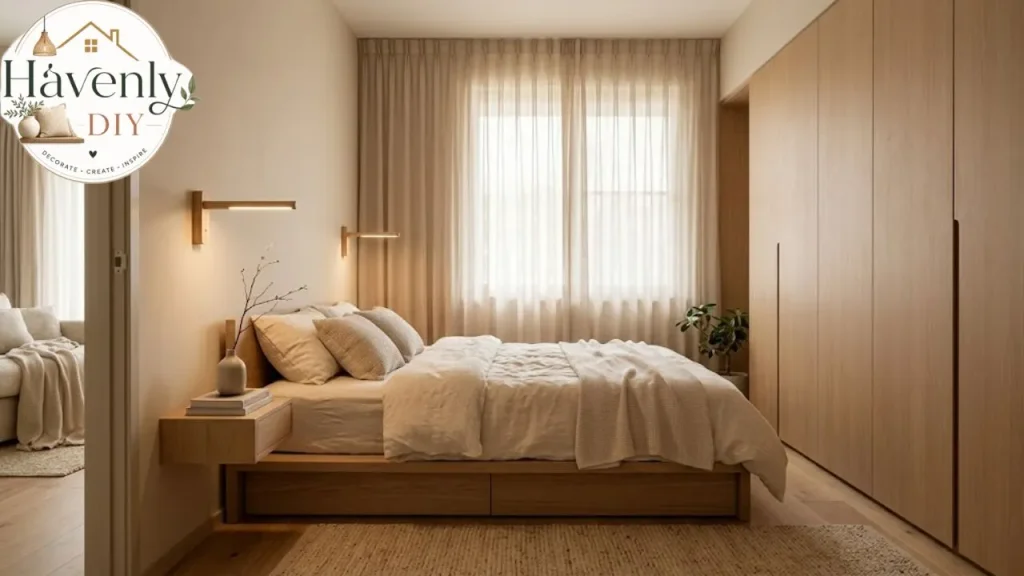
Movement zone: the clear route around the bed. If you can see the floor around your furniture, the room immediately feels less congested. For very small rooms, a low bed with integrated drawers can be especially effective.
Current 2026 small-bedroom guidance repeatedly emphasizes low-profile furniture, hidden storage, and clear circulation. Use wall-mounted lighting instead of bulky bedside lamps if necessary. Use a narrow nightstand instead of a wide one.
Use one large piece of artwork instead of a gallery wall. And don’t sacrifice every inch of space for storage. A bedroom needs breathing room.
Japanese Bedroom Design for Renters
You can create the look without renovation. Try:
- warm linen bedding
- a low freestanding bed
- paper or fabric lamps
- removable shoji-inspired screens
- natural wood accessories
- a neutral rug
- hidden cable storage
- simple curtains
- one ceramic vessel
- one plant
No tatami installation required. No permanent wall changes required.
How to Make It Japanese Without Making It Look Themed
This is where many rooms go wrong. Avoid using every recognizable Japanese symbol at once. You don’t need:
- bamboo everywhere
- bonsai everywhere
- kanji artwork everywhere
- paper lanterns everywhere
- cherry blossom prints everywhere
Instead, choose three layers.
Architecture
Low furniture, open floor, simple lines.Materials
Wood, linen, paper, ceramic, woven textures.
Meaning
One or two carefully selected decorative pieces. When the architecture and materials are right, you need surprisingly little decoration.
Japanese Bedroom Mistakes to Avoid
Confusing minimalism with emptiness
Minimalism should make the room easier to live in. It shouldn’t make you feel like you’ve moved into a furniture showroom.
Buying a futon for appearance alone
If you won’t maintain it properly, don’t buy it.
Using too many “Japanese” accessories
One meaningful object usually looks better than a shelf full of souvenirs.
Ignoring climate
Natural materials and floor sleeping systems need to work with the humidity and ventilation of your home.
Forgetting storage
A room can’t stay visually peaceful if there is nowhere to put clothes.
Making everything beige
Japanese-inspired design can include charcoal, deep brown, muted greens, and other earthy tones.
Making everything perfectly symmetrical
Balance doesn’t always mean mirror-image symmetry.
Using harsh lighting
The wrong light can destroy an otherwise beautiful bedroom.
How Much Japanese Style Do You Actually Need?
Think of it as a spectrum. 10% Japanese: low wood bed + linen bedding. 30% Japanese: add natural materials, warm lighting, and edited decor. 50% Japanese: introduce screens, stronger architectural cues, and Japanese-inspired storage.
80%+ Japanese: tatami, futon/shikibuton, traditional screens, low furniture, and more authentic spatial elements. There is no requirement to reach 100%. For most homes, 30 to 50% is enough to create the feeling without sacrificing comfort.
A Simple Weekend Japanese Bedroom Makeover
If you’re starting from scratch, don’t buy everything at once.
Friday evening
Remove obvious clutter. Take everything off surfaces. Decide what actually belongs in the bedroom.
Saturday morning
Rearrange the furniture. Create the clearest possible walking path. Remove anything oversized or unnecessary.
Saturday afternoon
Add the foundation:
- bedding
- low furniture
- curtains
- rug
- storage
Saturday evening
Fix lighting. Turn off the harsh overhead fixture and test your room with bedside and ambient lighting.
Sunday
Add personality. Choose one plant, one artwork, and one tactile object. Then stop. Live with the room for a week before buying anything else. That’s how you avoid replacing one kind of clutter with another.
The Best Japanese Bedroom Is the One You Can Actually Live In
Japanese-inspired design is often described using words like serenity, harmony, and simplicity. Those words are attractive, but the practical version is even better. A calm bedroom is a room where:
- clothes have somewhere to go
- cables aren’t everywhere
- lighting can become soft at night
- the bed doesn’t dominate the entire room
- furniture doesn’t block movement
- materials feel pleasant
- the floor has some breathing room
- decoration has been chosen rather than accumulated
Traditional Japanese bedroom offer plenty of inspiration here. Their architecture demonstrates how tatami, sliding screens, storage, seasonal decoration, and relationships with gardens can create adaptable spaces rather than simply attractive rooms.
You don’t need to reproduce a historical Japanese house. Take the parts that improve your life. Keep the low visual weight. Keep the natural materials. Keep the quiet lighting. Keep the space. Then make the room yours. That is far more convincing than turning your bedroom into a collection of Japanese-themed objects.
Frequently Asked Questions
What is a Japanese bedroom?
A Japanese-inspired bedroom emphasizes simplicity, natural materials, low furniture, uncluttered space, soft light and intentional decoration. A traditional Japanese room, or washitsu, is more specific and is typically associated with tatami and traditional sliding elements such as shoji and fusuma.
Do Japanese bedrooms always have futons?
No. Traditional Japanese sleeping arrangements can use futons, but modern Japanese bedrooms may use conventional mattresses and low platform beds.
Do I need tatami to create a Japanese bedroom?
No. Tatami is important to traditional washitsu design, but hardwood flooring, woven rugs and low furniture can create a modern Japanese-inspired room.
What colors are best for Japanese bedroom design?
Warm whites, beige, natural wood, soft gray, charcoal, muted green and earthy brown are strong choices.
What is the difference between Japanese and Japandi bedrooms?
Japanese design draws directly from Japanese aesthetics and spatial traditions. Japandi combines Japanese restraint with Scandinavian simplicity, warmth and functionality.
Is Japanese bedroom design good for small rooms?
Yes. Low furniture, clear floor space, hidden storage and restrained decoration can make small bedrooms feel less visually crowded.
How do I make a Japanese bedroom cozy instead of cold?
Use texture. Linen, wool, cotton, natural wood, warm lighting, woven materials and handmade ceramics add warmth without creating clutter.
Can I create Japanese bedroom style on a budget?
Yes. Keep your existing bed if necessary and focus on lighting, bedding, decluttering, wood tones, curtains and one or two meaningful decorative pieces.