

A laundry room can have beautiful finishes and still be annoying to use. The problem is usually not the washer or dryer. It is everything around them. There is nowhere to put the detergent. The baskets end up in the walkway. Cleaning sprays gather beside the sink.
An ironing board leans against a wall. Towels get stacked wherever there is an empty inch. That is why the best laundry room cabinets are not simply the ones with the prettiest doors. They are the ones that make the room easier to move through.
Before choosing a cabinet color or hardware, think about what happens in the room from the moment you walk in with a basket of dirty clothes until the last clean shirt leaves. That simple change in thinking can completely alter the layout.
Start With How You Actually Use the Room
Begin with your routine rather than a cabinet catalog. Ask yourself:
- Where do dirty clothes arrive?
- Do you sort them in the laundry room?
- Do you air-dry clothing?
- Where do you fold?
- Where do you store detergent?
- Do towels and linens live here?
- Do you keep cleaning products nearby?
- Where does the ironing board go?
- Do you need space for a vacuum, broom, or mop?
- Is the room also a mudroom or pet-washing area?
A person who does laundry several times a week may benefit more from a generous folding counter than from another tall cabinet.
A family with young children may prioritize locked, high storage for laundry products. The American Academy of Pediatrics recommends keeping laundry products out of sight and reach and specifically advises against leaving detergent packets on top of machines or other accessible surfaces.
Someone with a tiny laundry closet may need almost no lower cabinetry at all. The right question is not, “How many cabinets can I fit?” It is, “Which storage problems happen every week?” Solve those first.
Choose the Layout Before the Cabinet Style
There are four common starting points.
Side-by-side washer and dryer
This is usually the easiest arrangement for cabinetry because the machines create a long, predictable working zone. A practical arrangement is:
upper cabinets + washer + dryer + counter or side storage
Upper cabinets can hold everyday laundry supplies, while a base cabinet or tall cabinet elsewhere can handle bulkier items. If the machines are front-loaders, a countertop above them can create a useful folding surface. Just remember that the exact appliance dimensions, door swing, and installation requirements come before the cabinet dimensions.
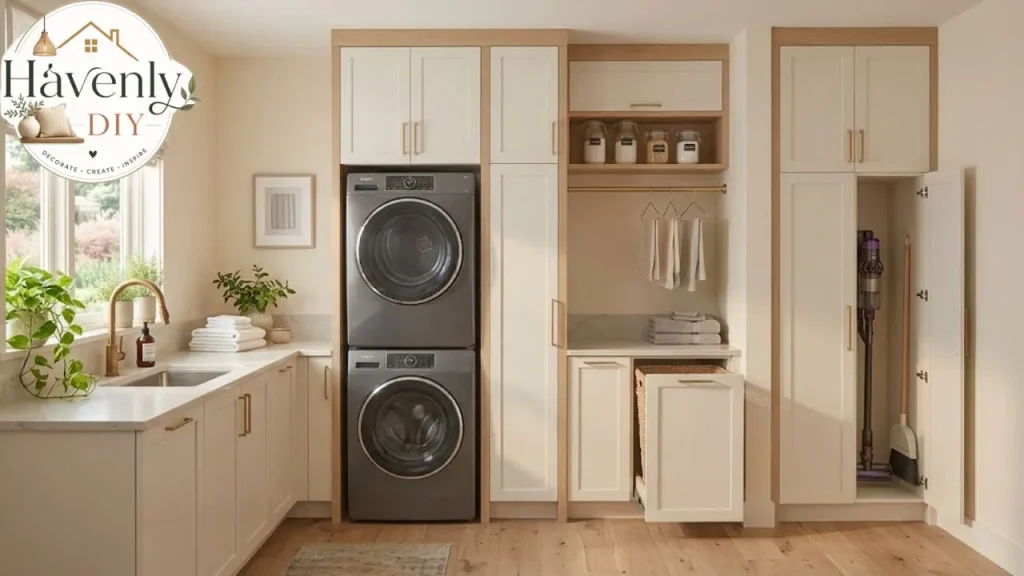
Stacked washer and dryer
Stacking saves floor space but changes the storage strategy. Instead of filling the wall immediately above the machines, consider:
- A narrow cabinet beside the stack
- A tall utility cabinet
- Shallow shelves
- A pull-out hamper
- A nearby folding surface
The upper portion of a stacked installation can be difficult to reach, so don’t automatically turn every available inch into storage. A cabinet that requires a step stool for something you use twice a day is not necessarily efficient.
Laundry closet
A closet rewards restraint. Deep cabinets can make a narrow space feel even narrower. In many cases, shallow upper storage combined with one narrow tall cabinet is more useful than a wall of bulky cabinetry. Pay close attention to doors. A cabinet door, closet door, and appliance door all need somewhere to swing.
Multipurpose utility room
This is where cabinetry can become much more ambitious. You may be able to include:
- A utility sink
- Folding counter
- Linen storage
- Cleaning-supply cabinet
- Pet supplies
- Hanging area
- Shoe storage
- Mudroom lockers
The danger is designing for storage capacity rather than movement. A laundry room still needs breathing room.
Upper Cabinets: The Easiest Storage Win
For many homes, upper cabinets are the first place to start. Common cabinet planning guidance puts wall cabinets around 12 inches deep, although actual dimensions should be adapted to the room and appliance arrangement.
Homes & Gardens also notes that standard kitchen-style cabinets can work in laundry rooms when their dimensions and materials suit the application. That shallower depth is useful because it gives you storage without projecting dramatically into the room. Use upper cabinets for things such as:
- Detergent
- Stain remover
- Dryer sheets
- Towels
- Cleaning cloths
- Spare laundry bags
- Hangers
- Small household supplies
Adjustable shelves are particularly valuable. Laundry supplies change size. One bottle may be short and wide while another is tall and narrow. Fixed shelves can leave awkward dead zones.
If you are storing chemical products, keep the most hazardous items secured appropriately rather than placing them in an easily accessible lower drawer.
Should cabinets go directly above the washer and dryer?
Often, yes. But don’t treat a standard measurement as permission to install cabinetry without checking the appliance manual. Manufacturers specify clearances differently. For example, appliance installation guidance can require space around the unit for airflow, hoses, service access,s and ventilation.
LG’s current installation guidance gives specific side and rear clearances for particular washer-dryer models and advises against enclosed locations exposed to excessive heat or moisture. Your appliance manual wins over a generic cabinet diagram every time.
Base Cabinets and the Folding Counter
If upper cabinets hide the clutter, a good countertop can make the room easier to live with. A folding counter gives you a dedicated place to:
- Fold shirts
- Sort clothing
- Stack towels
- Set down a basket
- Organize clean laundry before it leaves the room
Common base cabinetry is around 24 inches deep, similar to kitchen base cabinets. But don’t assume you need a full 24-inch cabinet everywhere. A shallow section may be better in a narrow room if it protects the walking path. This is one of the most important planning principles:
Storage is only useful when you can comfortably reach it.
A huge counter that forces you to squeeze sideways between the machines and the opposite wall is not an upgrade.
Tall Cabinets Are for the Awkward Stuff
Tall cabinets are often the missing piece in laundry rooms. They can swallow objects that are difficult to store elsewhere:
- Brooms
- Mops
- Vacuum attachments
- Ironing boards
- Drying racks
- Dustpans
- Cleaning tools
- Bulk paper products
- Extra linens
A tall cabinet also lets you keep these visually messy objects behind one door. Pull-outs can make tall storage easier to use, particularly for cleaning tools. Current design guidance increasingly recommends vertical utility cabinets and pull-out storage because they use otherwise wasted wall height.
One caution: don’t fill the uppermost shelves with things you use constantly. Store seasonal or rarely needed items high. Keep daily supplies between waist and eye level.
Small Laundry Room Cabinets Need a Different Strategy
Small rooms punish unnecessary depth. Instead of trying to copy a large laundry room, use three principles:
Go upward
A narrow floor-to-ceiling cabinet can add significant capacity without consuming much floor area.
Keep frequently used items close.
Put detergent and stain treatment where you can reach them while standing at the machines.
Hide clutter selectively
You don’t need every surface enclosed. A combination of closed cabinetry and one useful open shelf can make a small room feel less visually heavy.
For example, a narrow cabinet beside stacked machines can hold cleaning tools while a shallow shelf nearby handles everyday baskets. Current small-space designs increasingly use pull-out hampers, fold-down work surfaces, and tall slim storage to solve this problem.
Standard Cabinet Dimensions: Use Them as Starting Points
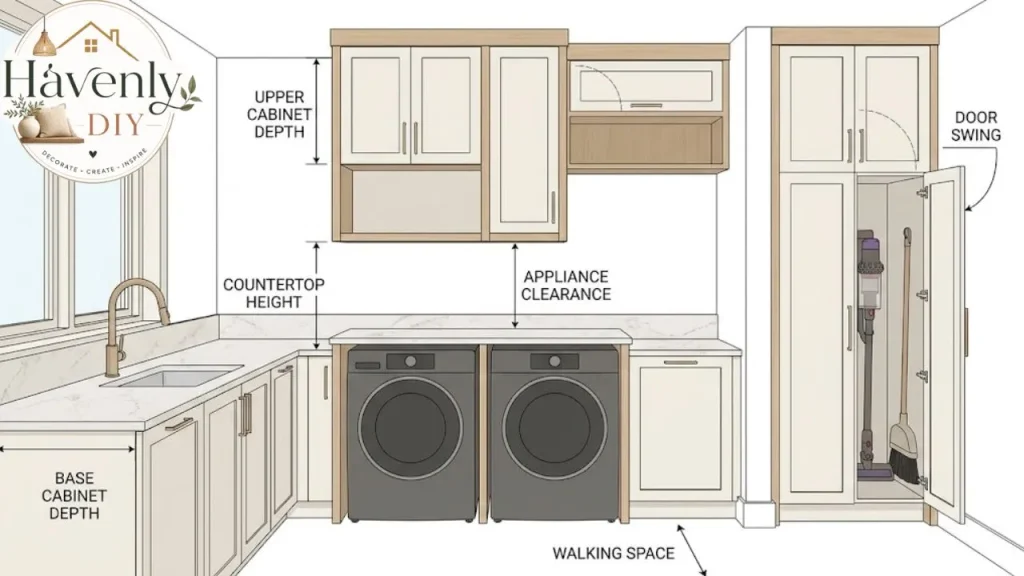
There is no single universal laundry cabinet dimension because appliances vary. Still, these common starting points are useful:
| Cabinet element | Common starting point |
|---|---|
| Upper cabinet depth | About 12–15 inches |
| Base cabinet depth | About 24 inches |
| Base cabinet height before countertop | About 34–35 inches |
| Folding counter finished height | Often around 36 inches |
| Tall utility cabinet | Often 84–96 inches |
These are planning benchmarks, not installation guarantees. Before ordering anything, measure:
- Wall-to-wall width
- Floor-to-ceiling height
- Appliance width
- Appliance depth
- Appliance height
- Door swing
- Water connections
- Drain location
- Electrical outlet location
- Dryer vent location
- Gas connection if applicable
- Baseboard and trim
- Door and walkway clearance
Then compare those measurements with the exact installation manual for your appliance. That final step is where many attractive cabinet plans fall apart.
Don’t Forget What Happens Behind the Machines
A cabinet can look perfect from the front and still create a problem behind the appliance. Washers and dryers need access to plumbing, electrical connections, ventilation, and service components. Dryers deserve particular attention.
Manufacturer installation instructions can specify ventilation requirements and clearance around exhaust systems. Whirlpool documentation, for example, provides detailed dryer venting requirements, while other manufacturers provide specific clearance requirements for closet or built-in installations.
If you are enclosing appliances behind doors, never assume that a beautiful cabinet door can simply be added around them. Some appliances require ventilation openings or particular clearances.
ASKO guidance, for example, describes ventilation requirements for appliances installed in cabinets or closets and recommends louvered or ventilated doors for certain enclosed configurations.
The exact requirements depend on the appliance. That is why cabinetry should be planned around the machine’s installation instructions, not the other way around.
Choose Cabinet Materials for the Room You Have
Laundry rooms are not bathrooms, but they can still expose cabinetry to humidity, splashes,s and occasional leaks. Material selection should reflect that environment.
Plywood
Plywood is a strong choice for cabinet boxes when durability and moisture tolerance matter. It also holds screws and hardware well.
MDF
MDF can produce smooth painted surfaces and may be perfectly reasonable in suitable conditions, but exposed or poorly sealed edges are vulnerable to moisture. If your laundry room has a history of leaks or high humidity, material and edge protection deserve extra attention.
Thermofoil
Thermofoil is easy to clean and gives cabinetry a uniform finished surface. However, installation conditions and heat exposure matter. Homes & Gardens specifically cautions readers to consider how some thermofoil products respond to heat and moisture.
Laminate
Laminate can be practical for a hardworking utility room because the finished surface is easy to wipe down.
Solid wood
Solid wood is attractive and durable but naturally responds to changes in humidity. It can be excellent for doors and decorative elements, but it is not automatically the best answer for every component. The best material depends on construction quality, finish, ventilation, moisture exposure, and budget.
Storage Features Worth Paying For
Not every cabinet upgrade is worth the money. Some are.
Adjustable shelves
A small upgrade with a big payoff.
Pull-out hampers
Excellent if you sort laundry in the room.
Soft-close hardware
Useful in a room where doors and drawers get opened constantly.
Full-extension drawers
Helpful when the back of a deep drawer would otherwise become a storage graveyard.
Pull-out utility storage
Particularly useful for narrow cabinets containing bottles or cleaning tools.
Hanging rods
If you air-dry shirts, a simple rod can be more valuable than another decorative shelf.
A dedicated folding surface
If you currently fold laundry on a bed or sofa, this can have more daily impact than expensive cabinet doors.
Features That Can Waste Money
More cabinetry does not automatically equal better cabinetry. Be cautious about:
- Extremely deep upper cabinets
- Shelves you cannot comfortably reach
- Decorative glass doors for messy supplies
- Oversized cabinets around stacked machines
- Intricate molding that traps dust
- Built-in features you rarely use
- Cabinets that block service access
- Excessive open shelving
A laundry room gets dusty, linty, and busy. Easy cleaning has real value.
Custom vs. Stock vs. DIY Cabinets
Stock cabinets
Best when:
- Your walls are relatively straightforward
- Standard dimensions fit
- You want to control the budget
- You don’t need unusual storage
Kitchen-style stock cabinetry can work well in laundry rooms, and existing cabinet systems can sometimes be adapted.
Semi-custom cabinets
A good middle ground when you need unusual widths, colors, or internal storage.
Custom cabinets
Worth considering when:
- The room has awkward corners
- You need floor-to-ceiling fitting
- Appliances must be integrated tightly
- You need specialized hampers
- The laundry room doubles as a mudroom
- Every inch matters
DIY
DIY can make sense for homeowners comfortable with measuring, building, and finishing cabinetry. The expensive part of DIY is rarely the plywood alone. It is the mistakes.
A cabinet that is one inch too deep can affect a door. A misplaced outlet can become inaccessible. A poorly planned utility connection can force you to rebuild a cabinet. Measure first. Build second.
Three Practical Laundry Room Plans
Plan A: Small laundry closet
Use:
- Stacked machines
- One narrow tall cabinet
- Shallow upper storage
- Pull-out hamper
- Wall-mounted hanging rod
Skip bulky lower cabinets unless you genuinely need them.
Plan B: Average laundry room
Use:
- Side-by-side machines
- Upper cabinets
- Countertop folding area
- One tall utility cabinet
- Small hanging zone
- Base drawers or hamper
This is the most balanced arrangement for many households.
Plan C: Large utility room
Use:
- Side-by-side appliances
- Full-height storage
- Folding counter
- Utility sink
- Linen cabinet
- Hanging area
- Cleaning-tool cabinet
- Mudroom or pet-storage zone
Here, the goal is not merely hiding laundry supplies. It is creating a genuine household work center.
Make the Cabinets Look Good Without Making Them Precious
A laundry room can be practical and still have personality. White cabinets remain an easy choice because they make the room feel clean and bright. But there is no rule saying utility cabinetry has to be white. Blue, green, warm wood, muted gray, and darker painted finishes can all work.
ELLE Decor’s current laundry-room coverage highlights the growing use of stronger cabinet colors and more intentional hardware, reflecting a broader design shift toward treating laundry rooms as finished spaces rather than purely utilitarian corners.
If the cabinetry is colorful, keep the surrounding finishes quieter. If the cabinets are simple, hardware or lighting can provide the visual interest. The best-looking laundry rooms usually have one clear focal point rather than six competing ones.
Lighting Matters More Than Most Cabinet Guides Admit
Cabinet planning should include lighting. A laundry room needs enough light to:
- Read garment labels
- Identify stains
- Match clothing colors
- Find small items
- Clean shelves
- See inside cabinets
Under-cabinet lighting can be especially useful over a folding counter. A ceiling fixture alone may illuminate the room but still leave the counter in shadow. Think about where your hands actually work. Light that falls on the task is more useful than light that merely makes the room bright.
Common Cabinet Mistakes to Avoid
Ordering before measuring the machines
This is probably the most expensive mistake.
Forgetting hoses and vents
The cabinet drawing may fit. The real installation may not.
Making upper cabinets too deep
Storage capacity means little if reaching the back is uncomfortable.
Ignoring door swing
Measure the appliance doors as well as the cabinet doors.
Putting everyday supplies too high
Save high shelves for occasional-use items.
Building around a future appliance that may not match
If you expect to replace the washer or dryer soon, leave reasonable flexibility.
Forgetting maintenance access
A washing machine eventually needs service. Don’t build a beautiful box that becomes a nightmare to open.
The Best Cabinet Layout Follows a Simple Rule
Put the things you use most where your hands naturally go. Detergent should not require a stool. The ironing board should not have to be dragged from behind the dryer. Clean clothes should have somewhere to land.
A stain-removal product should be easy to reach when a shirt has just been discovered with a fresh coffee mark. That is what good cabinetry does. It removes small points of friction from a routine you repeat over and over.
And that is why the best laundry room cabinets are not necessarily the most expensive ones. They are the ones that quietly make the entire room work better.
Before installation, check the exact appliance manuals, local requirements,s and any relevant ventilation instructions. Cabinet standards are useful starting points, but the machines in your room ultimately determine what can safely and practically be built around them.
Frequently Asked Questions
How deep should laundry room cabinets be?
Upper cabinets are commonly around 12–15 inches deep, while base cabinets are often around 24 inches. The correct depth depends on your appliances, walkway, ay and storage needs
Can you use kitchen cabinets in a laundry room?
Yes. Standard kitchen-style cabinets can work well when their dimensions, materials, and installation suit the laundry environment. Always check appliance clearances and moisture exposure.
Should I put cabinets above my washer and dryer?
Usually, upper cabinets are one of the most efficient ways to add storage. Keep them shallow enough for comfortable access and verify the appliance installation requirements first.
What should go inside laundry room cabinets?
Store detergent, stain treatments, towels, cleaning cloths, hangers, and other household supplies. Bulky tools such as mops and ironing boards are usually better suited to tall utility cabinets.
What is the best material for laundry room cabinets?
There is no single best material. Plywood, laminate, MDF, thermofoil, and solid wood can all work in the right application. Moisture exposure, sealing, construction quality,y and ventilation matter.
How do I maximize a tiny laundry room?
Use vertical storage, shallow upper cabinets, narrow tall cabinets, pull-out hampers, and multifunctional surfaces. Avoid filling the walkway with deep cabinetry.
Should laundry cabinets have doors?
Closed doors are excellent for hiding detergent bottles, cleaning products, and general visual clutter. Open shelves can work well for attractive baskets or frequently used items.
Can I hide a washer and dryer inside cabinets?
Sometimes, but only when the appliance’s installation requirements permit it. Enclosed installations may require specific clearances or ventilation openings. Follow the appliance manufacturer’s instructions.