

A bare wall in a living room is wasted space. Most people fill the floor first and run out of room before they look up.
This guide covers living room wall furniture: what it is, which types work, how to size it, how to hang it safely, and which styles suit which rooms.
I am not an installer or engineer. Follow your product’s instructions and weight limits, and use a professional for heavy or built-in work.
What Living Room Wall Furniture Is
Living room wall furniture is any storage or display piece that hangs from or fixes to the wall instead of standing on the floor. Floating TV consoles, wall units, shelves, and wall-hung cabinets all count.
It frees floor space, makes cleaning easier, and lets a small room breathe. The trade-off is load: everything depends on the wall behind it.
Home Depot’s media center ideas page, last updated September 7, 2023, groups the options simply: built-in units, floating shelves, gallery walls, wallpaper accents, libraries and repurposed furniture.
The Main Types
Each type solves a different problem, so pick by what you need to store.
Floating TV consoles
A floating console is a low cabinet or shelf that mounts to the wall under or beside the screen. It keeps cables tidy and leaves the floor visible.
Check the maker’s weight limit before you buy. One retail guide says to compare the total weight against the manufacturer’s stated maximum and never exceed it, because overloading can pull the console away from the wall.
Wall units and media walls
A wall unit combines open shelves and closed cabinets. Home Depot says combining open shelving with closed cabinets hides cords, remotes, and devices.
It can be built from custom-cut lumber or premade wall-mounted shelving, according to the same page. In my view,w the premade route is usually cheaper and quicker.
One design site, OSMOZ magazine (September 26, 2026), says a media wall can feel custom for about 300 to 1,200 USD using paint, proportion, and smart storage. Treat that as a loose budget tier, not a quote.
Floating shelves
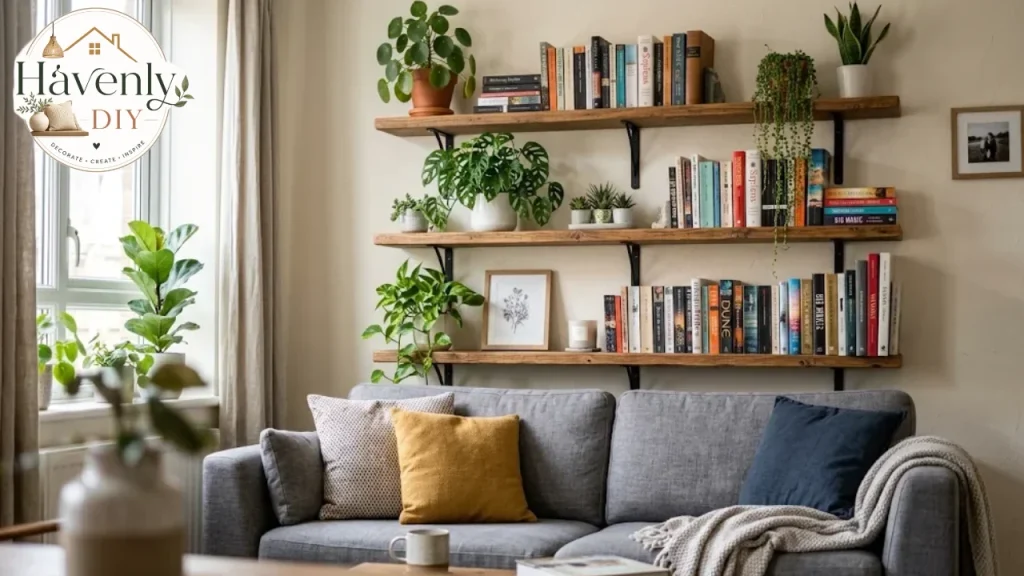
Shelves are the easiest first step. Home Depot suggests mounting them above a wall-mounted TV for a minimal look, and says they suit apartments, open plans, and narrow rooms.
Shelfology, a shelf maker, recommends living room shelves at 10 to 12 inches deep. Shallower shelves of 6 to 8 inches suit display or gallery walls.
Gallery walls and art-led walls
Home Depot also suggests surrounding the TV with art in place of shelves. Its tip is to lay pieces on the floor in front of the wall first to plan the layout.
Wall-hung cabinets and benches
Narrow wall-hung cabinets work beside a sofa or over a hallway bench. Keep them shallow, so heads and shoulders stay clear.
Our best home furnishings guide helps you pair these pieces with sofas and tables.
Sizing and Placement
Size is where most wall furniture goes wrong. A piece that is too small looks lost, and one that is too big feels heavy.
Start with the wall
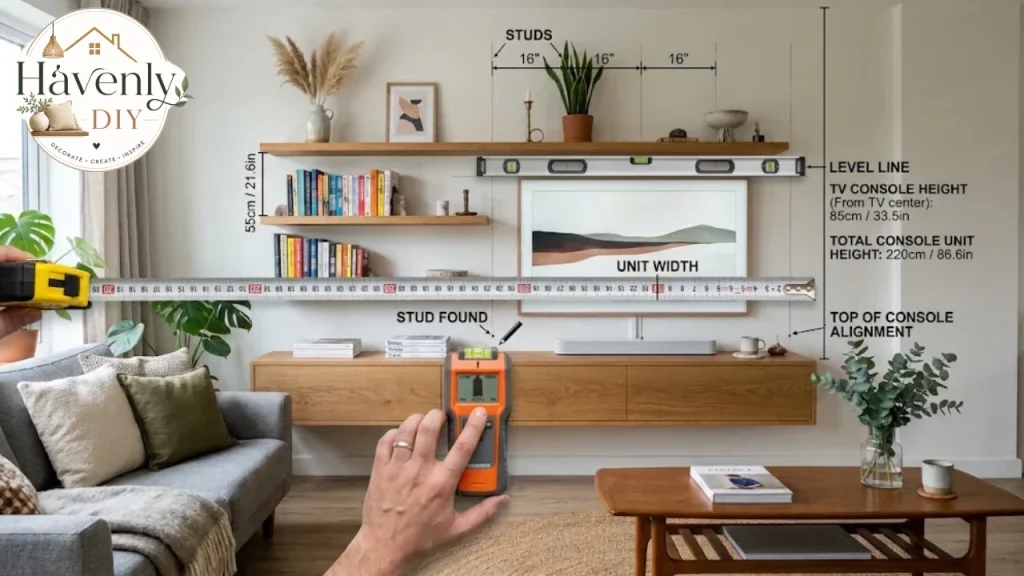
Measure the wall width and the clear space between windows, doors, and corners. Tape the outline on the wall with painter’s tape and live with it for a day.
My rule of thumb: leave a few inches of air at each side so the piece reads as intentional. This is a design habit, not a code rule.
Heights and spacing from Shelfology
Shelfology gives these planning numbers:
- Mount shelves at eye level, about 4 to 5 feet from the floor
- Place shelves about 10 inches above a sofa back or console
- Space stacked shelves 10 to 15 inches apart
They suit books and decor. For a TV, follow the screen maker’s mounting guidance instead.
Depth is a lever
Shelfology says deeper shelves hold less weight because depth acts as a lever arm. Weight placed farther from the wall increases the force on the mounting point.
Plan depth and load together. A deep shelf of heavy books needs stronger fixing than a shallow shelf of picture frames.
If your layout includes a fireplace, our fireplace hearth ideas show how wall furniture can flank it without crowding.
Mounting and Safety
Wall furniture fails at the wall, not the furniture. Plan the fixing first.
Find the studs
Shelfology says drywall alone will not hold a loaded shelf, and the strength comes from what is behind it. Studs are usually 16 or 24 inches apart on center, so verify with a stud finder.
It says one stud anchor holds roughly 45 to 50 pounds, while drywall anchors hold only a fraction of that. It recommends crossing at least two studs.
Weight limits
Shelfology says generic prong brackets begin failing above about 30 pounds. Its own shelves range from 25 to 350 pounds depending on bracket, rods, and studs used.
If no stud is available, it recommends heavy-duty toggle bolts rated for the load, with light contents. That is a maker’s advice, so treat it as a minimum standard, not a guarantee.
Ashdeco, a shelf retailer, says a small TV of up to 20 pounds can sit on a solid wood shelf with a French cleat into studs. For a TV of 40 pounds or more, it says to use a dedicated TV mount instead.
Anchor tall pieces and TVs
CPSC advises that furniture that could topple onto a child should be anchored to the wall. In a release dated November 26, 2019, it reported 459 child tip-over deaths in its 2000 to 2018 data.
The same release says 93 percent of child-specific incidents involved children 5 and younger. About 11,000 children per year were treated in emergency rooms for tip-overs in 2016 to 2018.
Of the child deaths, 37 percent involved falling TVs alone, 34 percent involved TVs and furniture together, and 24 percent involved furniture alone.
A later CPSC release dated November 16, 2022 says 581 tip-over fatalities involving furniture, TVs,s or appliances had occurred since 2000, 472 of them children. It adds that anti-tip kits cost about 20 USD or less.
The two releases cover different periods, so their counts differ.
Check your kit
CPSC has warned consumers to stop using Cranach Hardware plastic tip restraint kits because the plastic can break or degrade over time. Its recall notice says it knew of at least 115 incidents.
Check any strap kit you already own against current recalls on cpsc.gov.
A basic install sequence
- Mark the studs and the height with a level
- Check the piece’s weight and the hardware rating
- Drill pilot holes and fix into the studs
- Hang the unit and test it with gentle weight first
- Load heavy items low, as CPSC advises for furniture
Our home additions guide is useful if you are opening walls and can add blocking inside before the drywall goes up.
Styles That Work
Pick a style before you pick a product. Wall furniture is visible all day, so it sets the tone of the room.
Minimal and modern
Flat fronts, hidden handles, and one or two shelves keep a wall calm. OSMOZ suggests floating a console with a two-inch shadow gap to make it feel light.
I would keep this look to one or two materials, such as oak and matte white. More than that starts to feel busy.
Warm and layered
Mix open shelves with a closed base cabinet, and add baskets or bins to hide small clutter. Home Depot’s page lists baskets and bins as a way to store what you do not want to display.
For a more collected look, our modern eclectic interior design guide shows how to mix finishes without clashing.
Library wall
Home Depot suggests displaying books in cabinets with glass-inset doors or on open shelves. It recommends grouping books of similar colors together for a color-blocked library, and mixing in horizontal stacks.
Books are heavy. Use the stud and load rules above, and keep the deepest shelves for the lightest items.
Regional and home styles
Wall furniture should match the house. In a single-story plan like those in our ranch-style home guide, a long, low media wall suits the horizontal lines.
In a home with arches and textured walls, like those in our Spanish style homes guide, try warm wood shelves on a plaster-white wall. That pairing is my suggestion, not a rule.
Wall Color, Light and Cables
Paint can do as much as furniture. Home Depot suggests applying wallpaper to an accent wall or the back panel of a cabinet, and pairing busy patterns with neutral decor.
Pick the wall color first, then the furniture finish. Our home color combinations guide can help you choose a palette that holds up behind shelves.
OSMOZ lists a dark painted wall among its budget media-wall ideas, though it is a design site, not a technical source.
Hide the cables
Cables ruin a clean wall. Home Depot says built-in units can hide cords, remotes,s and devices behind closed doors.
CPSC also advises keeping TV and cable cords out of children’s reach. Plan the route before you fix anything, and ask an electrician about in-wall cable runs if needed.
Small Living Rooms
Small rooms gain the most from living room wall furniture, because floor space is scarce. A slim wall unit beats a deep floor cabinet by several inches of walkway.
Home Depot says floating shelves suit apartments, open floor plans,ns and narrow rooms. That matches how most small-space guides use them.
Shelfology’s 10-inch spacing above a sofa back helps here too. It keeps shelves clear of heads without wasting vertical space.
For student rooms and tight first apartments, see our dorm room ideas for guys. The same wall-first thinking applies.
If your living room is a rental, ask your landlord before drilling. Heavy pieces still need studs, so leaning toward a free-standing option may be smarter.
Layout Ideas That Work
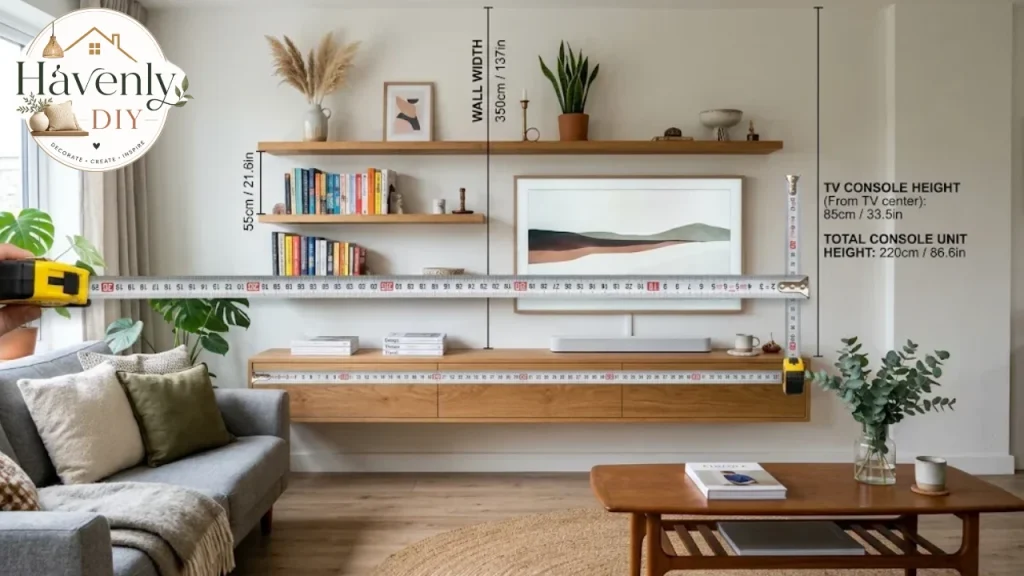
Here are four layouts I would try, each built on the sizing and mounting rules above:
TV wall with flanking shelves. Mount the screen on a dedicated bracket and add shelves on both sides.
Single long console with art above. Use Home Depot’s gallery approach and lay the art out on the floor first.
Sofa wall with three stacked shelves. Use Shelfology’s 10 to 15 inch spacing and keep decor light.
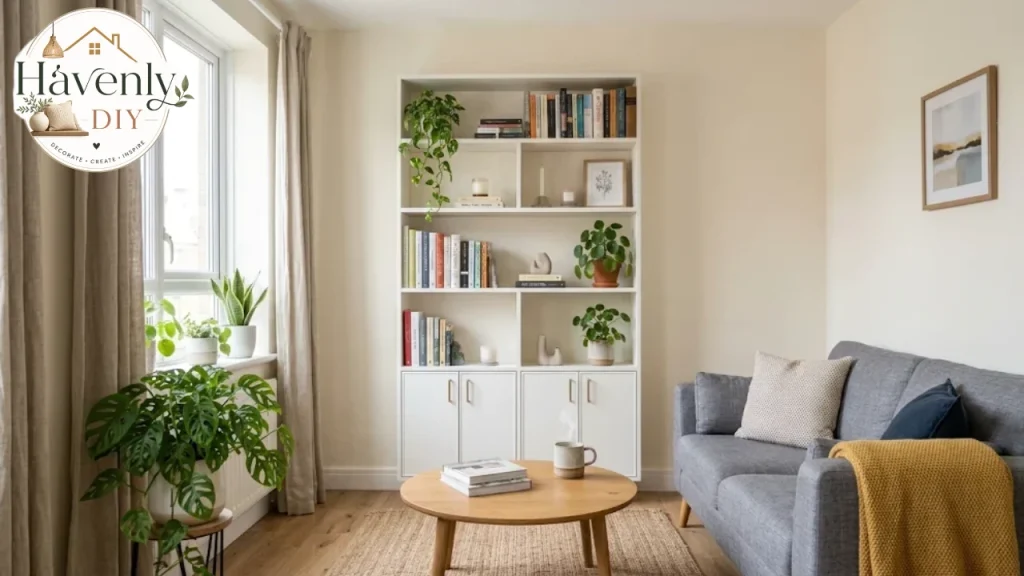
Corner wall unit. Use the corner for a library, and keep the heaviest books on the lowest shelf.
Whichever you choose, find the studs before you decide on the final position. The studs may move your layout by a few inches.
Budget and Where to Start
You do not need a full media wall on day one. Start with one piece and add as the wall proves itself.
OSMOZ puts a budget media wall at about 300 to 1,200 USD, built from paint, proportion,n and storage. A shelf kit and a stud finder sit at the low end of that range, and a custom unit sits far above it.
My approach to living room wall furniture on a budget: buy the fixings and the stud finder first, hang one shelf, and live with it. If it works, add a console.
Home Depot lists premade wall-mounted shelving as an alternative to custom-cut lumber. Compare the weight rating, not just the price.
A One-Weekend Plan
Here is a simple sequence for a first project. It assumes a drywall wall and a light-to-medium load.
Friday evening: measure the wall, tape the outline, and mark the stud positions
Saturday morning: buy the piece and the hardware rated for its weight
Saturday afternoon: fix the unit into the studs and test with a small load
Sunday: style it, lay the cables, and anchor any tall items
Good living room wall furniture should feel finished by Sunday night. If you hit plaster or masonry, stop and ask a professional, since those walls need different fixings.
When the project is done, step back and edit. Remove a third of what you put on the shelves, then add one plant or one framed piece.
Common Mistakes
Most problems with living room wall furniture start at the wall, not the piece.
Trusting drywall alone. Shelfology says drywall alone will not hold a loaded shelf.
Buying by looks, not load. Check the maker’s weight limit and the hardware rating before you buy.
Skipping the anchor on tall units. CPSC says furniture that could topple onto a child should be anchored. Tall wall units also belong on that list if they are not fully fixed.
Putting heavy items up high. CPSC advises storing heavier items on lower shelves or in lower drawers.
Ignoring cable routes. Plan power and signal before the unit goes up, since moving a fixed piece is harder.
Overfilling shelves. Leave air on each shelf. A packed wall reads as clutter even when it is neatly stacked.
FAQs:
What counts as living room wall furniture?
Any storage or display piece fixed to the wall, such as floating consoles, wall units, shelves,s and wall-hung cabinets.
How deep should living room shelves be?
Shelfology recommends 10 to 12 inches for living rooms, and 6 to 8 inches for display walls.
How much weight can a floating shelf hold?
It depends on the bracket and studs. Shelfology says one stud anchor holds roughly 45 to 50 pounds, and generic prong brackets begin failing above about 30 pounds.
Do I need studs?
For anything loaded or heavy, yes. Shelfology advises crossing at least two studs.
Can I put a TV on a floating shelf?
Ashdeco says a TV of up to 20 pounds can work on a solid wood shelf with a French cleat into studs, and a 40-pound TV needs a dedicated mount.
Should wall furniture be anchored for child safety?
CPSC says furniture that could topple onto a child should be anchored to the wall.
How much does a wall unit cost?
OSMOZ puts a budget media wall at about 300 to 1,200 USD. Custom builds cost more.
Is living room wall furniture good for small rooms?
Yes. It frees floor space and keeps walkways clear.