

Fireplace hearth planning should begin with the fire, not the tile. That sounds obvious, yet it is where many renovations go wrong. A homeowner falls in love with a slab of marble, a patterned porcelain tile or a sleek floor-level design before checking what the fireplace itself requires.
By the time the installer arrives, the chosen dimensions, thickness or construction may no longer make sense. A hearth has two jobs. It protects the surrounding building from heat, sparks and embers, and it visually anchors the fireplace within the room.
When those two jobs are considered together, the result tends to look better and perform better. Here is how to decide in the right order.
What exactly is a fireplace hearth?
The hearth is the noncombustible area at the base of a fireplace. The portion that projects into the room is commonly called the hearth extension. Its practical purpose is straightforward: it creates a protective area between the fire and combustible materials such as timber flooring, carpet and nearby finishes.
Building Code Trainer describes the hearth as the fireplace floor and the projecting area in front as the hearth extension. That distinction matters during renovation.
A decorative slab in front of an electric fireplace may look like a hearth, but it does not necessarily serve the same regulatory function as the masonry hearth associated with an open wood fire.
Hearth, firebox and surround are not the same thing
These terms are often mixed. The firebox is where combustion occurs. The hearth sits below and in front of it. The surround frames the opening vertically and horizontally.
The mantel is usually the shelf or upper architectural element. Knowing those names makes conversations with installers, stone fabricators, and inspectors much easier.
Why a hearth still matters
A traditional open fire can throw small sparks or glowing material beyond the firebox. Even where the flames remain contained, high temperatures close to combustible flooring create an obvious risk. That is why hearths are made from noncombustible materials.
The U.S. Fire Administration recommends using a tempered-glass or metal screen over a fireplace opening, keeping combustible items at least three feet away, and having fireplaces and wood stoves inspected before seasonal use.
The hearth is therefore one layer in a wider safety system. It does not compensate for a damaged chimney, incorrect appliance installation, or poor clearances. There is also a quieter design function. A large fireplace without a visually considered base can look strangely detached from the floor.
A well-proportioned hearth gives it weight. In a traditional room, it can reinforce the architecture. In a contemporary room, a flush stone plane can make the fireplace feel built into the building rather than placed against it.
Does every fireplace hearth need to follow the same rules?
No. This is one of the most important distinctions missing from many design articles.
Masonry fireplaces
For a masonry fireplace in a jurisdiction using the relevant International Residential Code provisions, the 2024 IRC requires the hearth extension to project at least:
| Fireplace opening | Front projection | Beyond each side |
|---|---|---|
| Less than 6 sq. ft. | 16 in. | 8 in. |
| 6 sq. ft. or larger | 20 in. | 12 in. |
The same code specifies a minimum 2-inch hearth-extension thickness, with an exception allowing certain thinner approved noncombustible materials where the firebox opening is raised at least eight inches above the extension. These are model-code provisions. Local adoption and amendments still matter.
Factory-built fireplaces
Do not automatically apply the masonry numbers to a factory-built unit. The 2024 IRC says approved factory-built fireplace hearth extensions should be installed according to the fireplace listing, with listed and labeled hearth extensions complying with UL 1618.
In practical terms, locate the model number and installation manual before changing the hearth. The manual may answer questions that no generic blog post can.
Gas fireplaces
Gas appliances vary considerably. Some units require hearth protection or specific clearances. Others are designed so a projecting hearth is optional.
The unit’s listing and installation instructions are therefore more reliable than a blanket statement that “gas fireplaces need hearths” or “gas fireplaces do not need hearths.”
Electric fireplaces
Because an electric fireplace has no burning wood, sparks or embers, a traditional protective hearth is often unnecessary.
Many homeowners still include one because it makes an electric fireplace look more architecturally grounded. In this case, you have considerably more design freedom, but the appliance manufacturer’s instructions still come first.
How large should the hearth look?
Minimum compliance and good proportions are not always identical. A hearth can technically satisfy a minimum and still look too small beneath a wide stone chimney breast. When the architecture is large, extending the hearth farther sideways can create visual balance.
Conversely, an oversized raised platform in a small room can interrupt circulation and consume valuable floor area. A useful design test is to view the fireplace from the room entrance rather than from directly in front of it. Ask:
- Does the base look substantial enough for the fireplace above?
- Does it cut awkwardly into a walkway?
- Does the furniture have to straddle it?
- Will the edge become a constant trip point?
- Does the material continue naturally into the surround?
Tape the proposed outline on the floor before ordering anything. It takes ten minutes and can prevent an expensive proportion mistake.
Choosing the best fireplace hearth material
There is no universal “best” material. The right choice depends on the appliance, required construction, heat exposure, maintenance expectations and the room around it.
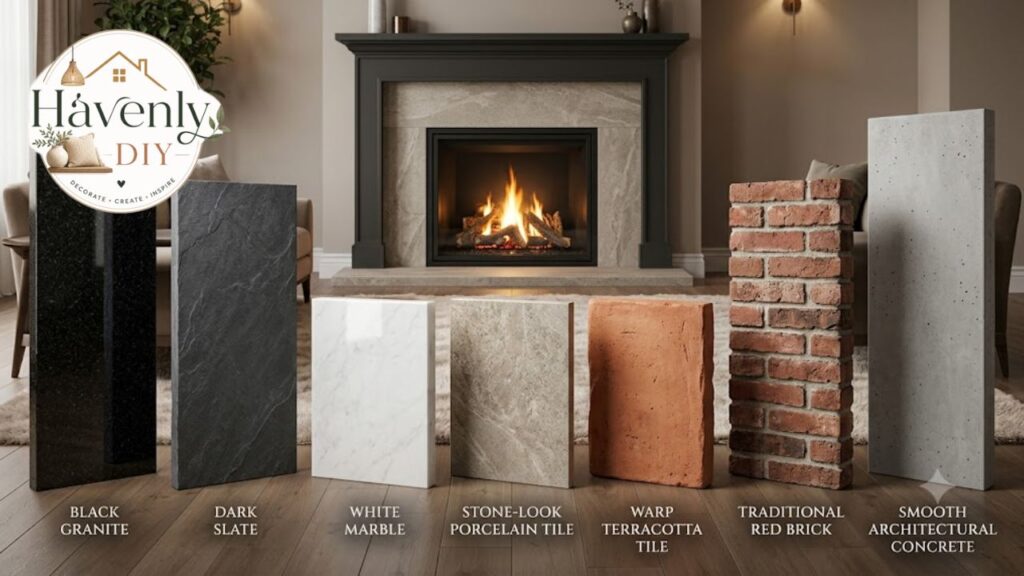
Granite
Granite is popular for good reason. It is dense, durable and visually versatile. Honed black granite works particularly well when you want the hearth to recede visually rather than dominate the room. Its smooth surface also makes ash easier to wipe away than heavily textured stone.
Where a hearth is exposed to significant thermal cycling, however, slab configuration, joints, and installation matter. Do not assume that because the stone itself tolerates heat, every single-slab installation is automatically suitable. Best for: clean contemporary or traditional installations where durability matters.
Slate
Slate has a softer, more natural visual texture. Dark slate hides soot well and pairs especially well with cast iron, timber and rustic interiors. Atlas Ceramics also highlights slate’s durability and ease of cleaning as reasons for its popularity.
The trade-off is inconsistency. Natural cleft surfaces can be more difficult to sweep than perfectly smooth stone, and some slate benefits from sealing. Best for: rustic, cottage, farmhouse and understated modern rooms.
Porcelain tile
Porcelain deserves more attention than it gets. It offers enormous design flexibility, low water absorption and comparatively straightforward maintenance. You can mimic limestone, marble, concrete or terrazzo without necessarily accepting the same maintenance burden as the natural material.
Large-format porcelain also reduces grout lines, which is useful where soot and ash are present. Homebuilding specifically favors porcelain over ceramic for fireplace applications because of its manufacturing characteristics and high firing temperature.
Best for: budget-conscious contemporary renovations and homeowners who want low maintenance.
Ceramic tile
Ceramic gives you extraordinary choice in color and pattern. It is particularly useful on decorative or lower-demand installations, although product suitability must be verified for the exact location and heat exposure. The challenge is not usually the visual surface. It is the whole assembly beneath it.
A beautiful tile over a weak, cracked, or moving substrate is still a weak hearth. Best for: decorative schemes where a suitable rated product is available.
Quarry and terracotta tile
These tiles are excellent when a hearth should feel like part of an older house rather than a new feature trying to imitate one. Terracotta brings warmth; quarry tile feels sturdy and familiar.
Both work especially well beside exposed brick and timber. Their porosity means sealing and stain expectations should be considered before installation.
Marble
Marble wins on appearance. Few materials can create the same sense of continuity when the same slab runs across a hearth and up a surround. It also demands realistic expectations. Marble can scratch, stain and etch more readily than harder or less porous alternatives.
If you expect muddy firewood, ash, tools and constant use, perfection may not last. That does not make marble unsuitable. It simply means the material should be chosen because you appreciate how natural stone ages rather than because you expect it to remain showroom-perfect.
Best for: formal and design-led rooms where appearance takes priority.
Limestone
Limestone has a quieter appearance than marble and usually sits beautifully in warm neutral interiors. Its softness and porosity vary by stone. Dark ash marks can be particularly noticeable on pale limestone if the surface is not properly protected and maintained.
Best for: traditional, Mediterranean and soft contemporary schemes.
Brick
Brick may be the easiest material to underestimate. It is inexpensive compared with many premium stones, simple to repair in sections and visually appropriate in older properties. Its textured surface and mortar joints do take more effort to clean.
Best for: traditional, farmhouse, industrial and deliberately rustic interiors.
Concrete
Concrete works when you want the hearth to look architectural rather than decorative. It can be cast into substantial forms, kept minimal, tinted or paired with lime plaster and stone. Hairline cracking and surface variation should be treated as part of the aesthetic rather than automatically as defects.
Best for: modern, brutalist, minimalist and custom-built fireplaces.
Raised hearth or flush hearth?
This decision changes the way the entire room works.
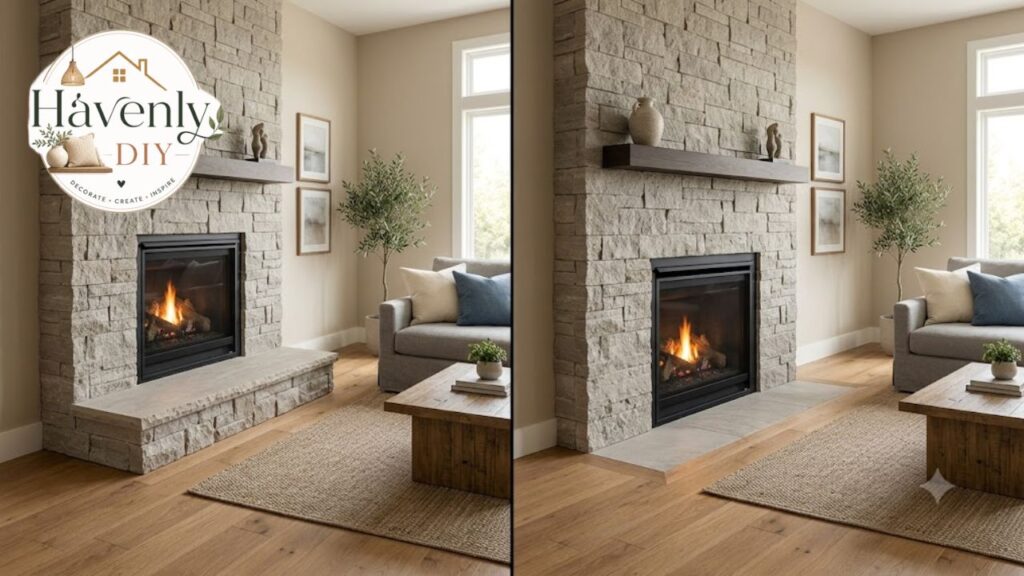
Why choose a flush hearth
A floor-level hearth creates a cleaner transition. It works particularly well with:
- modern interiors;
- open-plan rooms;
- uninterrupted timber or stone flooring;
- narrow circulation routes;
- minimalist fireplaces.
It can also reduce one common frustration: tripping over an unexpected raised edge. Homebuilding notes that raised hearths can interfere with furniture placement and floor planning, while recessing the hearth can recover usable floor area.
Why choose a raised hearth
A raised design brings the fire visually closer to seated eye level. A broad platform can also provide occasional seating when the fireplace is not in use, although comfort and proximity to an active fire must be considered.
Raised designs tend to feel more substantial and traditional. They may also make sense when the existing structure would require extensive demolition to produce a truly flush result.
Think about people, not just photographs
A sharp stone projection may look excellent in a staged interior but be frustrating beside a busy walkway. If there are young children, older residents, or people with reduced mobility in the house.
Edge geometry deserves as much attention as stone color. Rounded or carefully detailed edges can make a raised hearth feel deliberate rather than hazardous.
How to make the design feel intentional
The strongest hearths rarely try to do everything at once. If the surround already contains strong veining, carved detail, or patterned tile, a quiet hearth is often better. If the fireplace above is simple, the hearth can carry more character.
For a modern room
Consider:
- large-format porcelain;
- honed granite;
- flush installation;
- restrained grout lines;
- poured concrete;
- a full-width slab.
For a period room
Consider:
- quarry tile;
- checkerboard tile;
- terracotta;
- slate;
- marble;
- historically sympathetic borders.
For a rustic room
Natural irregularity works in your favor. Slate, brick and textured stone sit comfortably beside timber because they do not appear overly manufactured.
For a small room
Avoid assuming that dark material will automatically make the room feel smaller. A dark hearth can visually disappear into a dark firebox, making the overall fireplace appear simpler. The more important issue is physical projection. A deep raised platform consumes real space regardless of color.
Renovating an existing fireplace hearth
Renovation often becomes complicated when the old hearth is removed. The visible tile may be thin, but what lies beneath it can include mortar, masonry, leveling material, and structural support. Before demolition, determine:
- whether the existing hearth is structural;
- whether the fireplace is active;
- whether the appliance manual imposes requirements;
- what the adjacent floor height will be;
- whether the substrate is cracked or uneven.
Can you tile over an existing hearth?
Sometimes. An existing sound, stable and suitable noncombustible base can save considerable demolition work. But the finished height matters. Add the thickness of:
- leveling compound if required;
- mortar;
- tile;
- transition trim.
A “thin” new finish can suddenly sit noticeably above a hardwood floor. Recent renovation discussions illustrate exactly this problem: homeowners frequently discover uneven substrates after removing old hearth tiles or struggle to create a clean transition into plank flooring.
Pattern placement should be decided before adhesive
Dry-lay patterned tile. Do not discover after the first row is fixed that the centerline leaves narrow slivers at both edges. For a prominent fireplace, symmetry is visible from across the room.
Think about exposed tile edges
Raised tiled hearths create a vertical face. If the tile body is a different color from its glazed surface, an exposed cut edge can make an expensive project look unfinished. Options include:
- matching trim;
- stone edging;
- a mitered corner;
- a factory-finished tile edge.
This detail is easy to overlook during product selection.
Common mistakes that become expensive later
Choosing material before checking the fireplace
This reverses the correct decision order. Find the appliance requirements first.
Treating “noncombustible” as the only requirement
A material can be noncombustible while the complete assembly beneath it remains unsuitable. Substrate, thickness, support, and listing requirements still matter.
Copying generic dimensions to every fireplace
The familiar IRC masonry dimensions do not replace the installation instructions for a listed factory-built fireplace.
Ignoring grout
A mosaic looks wonderful on installation day. Then soot settles into dozens of grout joints. Choose grout color and joint width with maintenance in mind.
Using very pale porous stone without accepting patina
Ash, tools, and firewood are not gentle materials. A functioning hearth is a working surface.
Building a seat that is uncomfortable to use
If a raised hearth is supposed to double as seating, mock up the height first. A few inches dramatically change comfort.
Forgetting the fireplace screen
For active open fireplaces, a screen adds another layer of protection against sparks. The U.S. Fire Administration specifically recommends tempered-glass or metal screens.
Cleaning and maintaining the hearth
Maintenance should influence the material choice before installation, not after it.
Smooth granite and porcelain
Usually among the easiest to wipe clean. Keep abrasive tools away from polished surfaces.
Marble and limestone
Clean ash promptly and use products suitable for natural stone. Avoid assuming that a strong household cleaner is safe simply because it removes soot.
Slate
Vacuum or brush loose particles before wet cleaning. A textured cleft surface may hold dust more readily than honed stone.
Brick and terracotta
Porous surfaces can absorb discoloration. Appropriate sealing may simplify future maintenance.
Grouted tile
Pay attention to the grout rather than only the tile. The tile face may remain spotless while pale grout gradually darkens.
A five-step way to choose the right hearth
Rather than beginning with Pinterest, use this order.
Identify the fireplace
Write down the manufacturer and model where applicable. Determine whether it is masonry, factory-built, gas, electric, a stove, or an insert.
Establish the required footprint
Check the relevant local code and manufacturer documentation. Treat the minimum as a safety requirement, not necessarily your final design dimension.
Decide raised or flush
Consider circulation, accessibility, furniture and the existing construction.
Eliminate unsuitable materials
Remove options that conflict with heat exposure, required assembly, maintenance expectations, or budget. Only then compare colors.
Detail the edges and transitions
Decide how stone or tile will meet:
- hardwood;
- carpet;
- surrounding tile;
- vertical risers;
- fireplace surround.
Those junctions are often what separates a professional-looking hearth from an average one.
One final rule before you order anything
A beautiful fireplace hearth should look simple once it is finished. Getting there is not quite as simple. The most reliable projects start by identifying the fireplace and its requirements.
Then establish the correct construction and dimensions, and only afterward choose stone, tile, color, and pattern. That sequence is less exciting than selecting marble samples. It is also far less likely to leave you paying twice.
Frequently Asked Questions
What is the main purpose of a hearth?
Its primary functional role is to provide a noncombustible protective area around the base and opening of a fireplace, helping protect nearby flooring from heat, sparks, embers and ash.
How far should a hearth extend in front of a fireplace?
For masonry fireplaces under the 2024 IRC model provisions, the extension is at least 16 inches in front for openings under 6 square feet and 20 inches for openings of 6 square feet or more. Local codes and fireplace listings can differ.
Can a hearth be flush with the floor?
Yes, a properly designed system can be floor-level. The required construction still depends on the fireplace, applicable code, and manufacturer instructions.
What is the easiest hearth material to maintain?
Dense porcelain and smooth granite are generally among the easier surfaces to clean. Grout quantity, surface texture, and sealing requirements matter as much as the material name.
Is porcelain tile suitable for a hearth?
Suitable porcelain products are commonly used for hearths. Verify the product, installation system, and fireplace requirements rather than assuming every decorative tile is appropriate.
Does an electric fireplace need a hearth?
Many electric fireplaces do not require a traditional ember-protection hearth because no combustion occurs. Check the manufacturer’s installation instructions.
Does a gas fireplace need one?
It depends on the appliance. Listed gas units have model-specific clearance and installation requirements, so the manual should govern the decision.
Can I tile over an old hearth?
Potentially, if the existing assembly is sound, stable, appropriately constructed, and the additional finished height does not cause problems.