

A kitchen can have expensive countertops, beautiful lighting, and a spectacular backsplash and still feel dated. The cabinets usually give the game away. That is because cabinetry occupies so much visual space.
It establishes the rhythm of the room, controls how much storage you have, and often determines whether the kitchen feels calm or cluttered. The good news is that modern cabinetry is not limited to stark white doors and futuristic hardware.
The strongest kitchens being designed now are considerably warmer. Natural wood, softer colors, simple profiles, integrated storage, and carefully chosen hardware are creating spaces that feel contemporary without looking like they belong in a showroom.
If you’re planning a remodel, the trick is to look beyond the cabinet color. Construction, door style, finish, storage, and proportions matter just as much.
What makes modern kitchen cabinets look modern?
Modern cabinetry is primarily about visual restraint. The doors usually have little or no decorative detailing. Slab or flat-panel doors are the clearest example: one uninterrupted surface replaces raised panels, ornate profiles, and decorative molding.
But the modern appearance comes from more than the door itself. Look closely at a well-designed contemporary kitchen, and you’ll often notice:
- flat or very simple cabinet fronts
- full-overlay doors
- narrow, consistent reveals
- concealed hinges
- streamlined hardware
- large drawers instead of numerous small ones
- tall storage
- integrated appliances
- restrained color combinations
- carefully controlled wood grain
- clean transitions between cabinetry and other materials
Frameless cabinetry is especially common because removing the traditional face frame allows the doors and drawers to create a more continuous front. That does not mean every modern kitchen cabinet must be frameless.
A framed cabinet can still look thoroughly contemporary when the door style, overlay, hardware, and finish are handled well. This distinction matters because “modern” is a visual language, while “frameless” is a construction method.
Slab, flat-panel, or Shaker: which door style is actually modern?
Slab doors
Slab doors are the most immediately recognizable modern option. There are no raised centers, decorative rails, or recessed panels. The front is essentially one clean plane. They work particularly well when you want:
- a minimalist kitchen
- a European-inspired look
- handleless cabinetry
- strong wood grain
- a quiet backdrop for dramatic countertops
- easy-to-clean surfaces
The downside is that imperfections can become more visible. A simple door gives your eye fewer details to hide behind. That makes installation quality surprisingly important. If one drawer front is slightly crooked or the gaps are inconsistent, the problem is much easier to see.
Flat-panel doors
“Flat-panel” and “slab” are sometimes used interchangeably, although manufacturers may use the terminology differently. The important thing is the visual result: a clean front with very little ornamentation.
Shaker doors
Shaker cabinets are not exclusively traditional. A narrow-profile Shaker door in a full-overlay configuration can look distinctly modern, particularly when paired with simple pulls, a restrained color palette, and contemporary lighting.
This is an excellent option if you like the simplicity of modern cabinetry but don’t want an ultra-minimalist kitchen. It is also more forgiving stylistically if you think you may change your kitchen’s look later.
Frameless vs. full overlay: don’t confuse these two
This is one of the most useful distinctions to understand before ordering cabinets. Frameless describes cabinet construction. Full overlay describes how the door sits over the cabinet front. A frameless cabinet has no traditional face frame around the front opening.
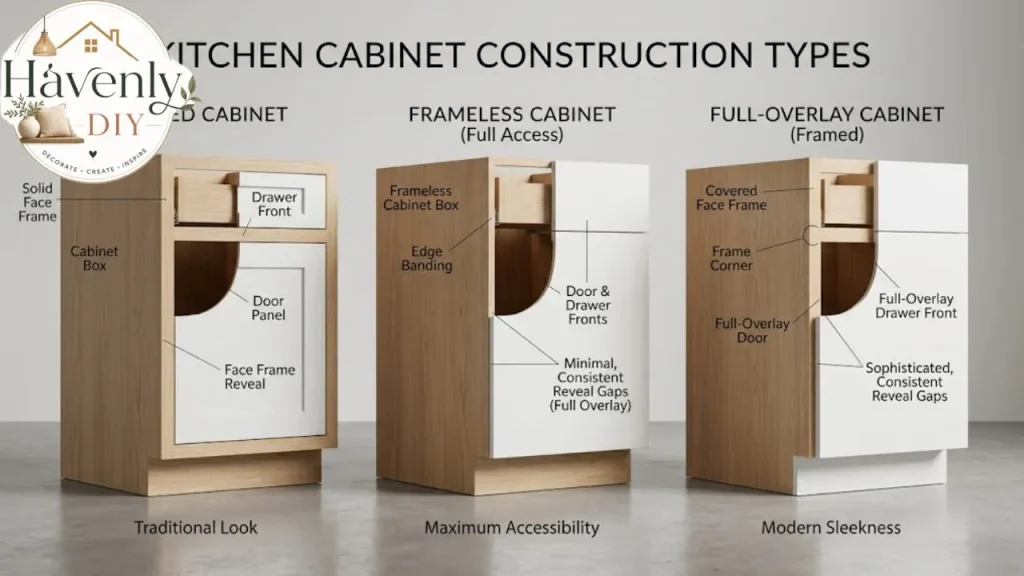
Full-overlay doors cover almost the entire visible cabinet front, leaving small, consistent reveals between doors and drawers. They are often used together, which is why the terms get mixed up. For a highly contemporary kitchen.
A frameless cabinet with full-overlay doors can produce the uninterrupted appearance many homeowners are trying to achieve. But don’t choose the construction simply because it sounds more modern. The cabinet box, hinges, drawer hardware, and installation quality ultimately matter more than the label.
The best materials for modern cabinets
There is no single “best” cabinet material. The right choice depends on your budget, humidity, cleaning habits, desired appearance, and how long you expect the kitchen to last.
Wood and wood veneer
Wood brings something modern kitchen cabinets desperately need: warmth. Oak and walnut are particularly effective because the grain provides visual interest without requiring decorative door detailing. Wood veneer can give you the appearance of real timber while allowing manufacturers greater consistency in panel production.
The most convincing modern wood kitchens generally avoid excessive matching. You don’t necessarily need every cabinet, shelf, and accessory to have the same grain direction. A little variation can make the room feel more like a home and less like a furniture catalog.
Plywood
Plywood is frequently considered a premium cabinet-box material because of its layered construction and strength. But don’t automatically assume that “plywood” means the entire cabinet is superior. Ask what parts are plywood.
The sides may be plywood while other components use engineered board. That can be perfectly reasonable, but you want to know what you’re actually purchasing.
MDF
MDF is a dense engineered wood product commonly used for painted cabinet doors because it provides a smooth surface. For painted slab fronts, MDF can be a sensible choice. Again, material selection should be judged in context rather than through a simple “real wood good, engineered wood bad” rule.
Laminate and other engineered finishes
Modern laminates can offer excellent consistency and are available in wood-look, matte and textured finishes. They’re particularly attractive when you’re trying to control cost while maintaining a contemporary appearance. The important question is not simply whether the finish looks good on a sample. Ask how it handles:
- heat
- moisture
- cleaning products
- scratches
- edge exposure
- everyday impact
Modern cabinet colors in 2026
The biggest mistake is interpreting a trend report as an instruction. You don’t need to replace white cabinets because wood is currently more popular. The 2026 U.S. Houzz Kitchen Trends Study found wood cabinetry at 29% among renovating homeowners, just ahead of white at 28%.
That is evidence of a shift, not proof that white has suddenly become a bad choice. The more interesting trend is toward warmth and natural materials.
Warm white
Warm whites are often easier to live with than very blue, stark whites. They work beautifully with:
- natural oak
- warm stone
- brushed metal
- cream backsplashes
- wood flooring
Natural oak
Oak has become one of the strongest choices for contemporary kitchens because the grain creates texture without decorative cabinetry. White oak in particular fits comfortably into minimalist, Scandinavian, organic-modern, and transitional spaces.
NKBA’s 2026 trend research also identifies natural materials as an important direction, with white oak standing out among wood choices.
Deep green
Green can work surprisingly well with modern cabinetry, especially when the color is muted rather than excessively bright. Think of the cabinet as part of the architecture rather than an accent object.
Greige and soft neutrals
If you want something quieter than white but less dramatic than black, greige, mushroom, taupe and soft gray-brown finishes can create a sophisticated middle ground.
Black
Black modern cabinets can look spectacular. They can also make a small, poorly lit kitchen feel heavier. If you’re considering dark cabinetry, look at the room at different times of day. A finish that looks beautiful under showroom lighting can behave very differently on a cloudy morning.
How to make a modern kitchen feel warm instead of sterile
This is where many minimalist kitchens go wrong. Clean lines are not the same thing as warmth. If everything is white, glossy, perfectly symmetrical, and reflective, the room may technically be modern while still feeling uncomfortable. Add contrast through materials rather than excessive decoration. A simple combination might be:
warm wood cabinetry + pale stone + soft lighting + brushed metal + textured backsplash. Another might be: matte green cabinetry + oak island + light countertop + aged brass hardware. You don’t need ten different materials. In fact, modern kitchens usually benefit from fewer materials used more intentionally.
Storage is where modern cabinetry earns its keep
A beautiful kitchen with inadequate storage becomes irritating very quickly. This is one area where current industry research is particularly useful. NKBA’s 2026 report highlights floor-to-ceiling cabinetry, drawers, walk-in and butler pantries, customized refrigerator storage, and storage-packed islands as important directions.
Think about how you actually cook. If you use heavy cookware every evening, deep drawers near the cooking zone may be more useful than a collection of narrow cupboards. If you buy bulk groceries, pantry storage may be worth sacrificing a little decorative space for.
If coffee is part of your morning ritual, a dedicated beverage area can make more difference than another display cabinet. Modern design should respond to behavior. It shouldn’t merely photograph well.
Features worth paying more for
If your budget is limited, spend money where you interact with the kitchen every day. Good candidates include:
- quality drawer runners
- soft-close hardware
- strong hinges
- full-extension drawers
- pull-out pantry storage
- deep drawers for pots and pans
- properly planned corner storage
- interior lighting where it genuinely helps
- durable finishes
- well-built cabinet boxes
You can often save money on decorative details that contribute little to daily function. A fancy decorative panel is difficult to appreciate when the drawer underneath it sticks.
Modern cabinet hardware: handles, pulls, or nothing?
Hardware can completely change the character of the same cabinet door. Long horizontal pulls emphasize the geometry of slab cabinetry. Small knobs soften the appearance. Integrated pulls provide an almost furniture-like surface.
Push-to-open mechanisms create the cleanest appearance, but they aren’t automatically the most convenient option for every household. Think about wet or greasy hands. Think about children.
Think about whether you actually enjoy opening a cabinet by pressing its front. A kitchen should not win a design award at the expense of being annoying to use.
Ceiling-height cabinets are more than a trend
Tall cabinetry can make a modern kitchen feel more architectural while giving you valuable storage. It also eliminates the awkward dust-collecting space above standard-height wall cabinets. But ceiling-height cabinetry should be planned around the room.
If your ceiling is uneven, very tall cabinetry can make that problem more noticeable. For older homes, this is an excellent example of why measurement and installation matter just as much as the cabinet itself.
Modern cabinets for small kitchens
Modern cabinetry can be particularly effective in compact kitchens because its clean surfaces reduce visual noise. Try:
- tall pantry units
- fewer but larger drawers
- full-overlay fronts
- light or medium-toned finishes
- integrated appliances
- under-cabinet lighting
- consistent cabinet colors
- vertical storage
Avoid filling every available wall with tiny compartments. A small kitchen can actually look busier when every inch is visually divided. Sometimes fewer, larger cabinet fronts create a calmer result.
Integrated appliances can make the kitchen look more architectural
Panel-ready refrigerators and dishwashers allow appliances to disappear into the cabinetry. This works especially well in open-plan homes where the kitchen is visible from the living room. But integrated appliances are not automatically better.
They can increase project complexity and cost, and appliance dimensions need to be coordinated with the cabinet design before installation. Never treat appliance selection as something to figure out after the cabinets have been ordered.
How to judge cabinet quality before you buy
This is where buyers should become slightly less interested in photographs and slightly more interested in specifications. Ask:
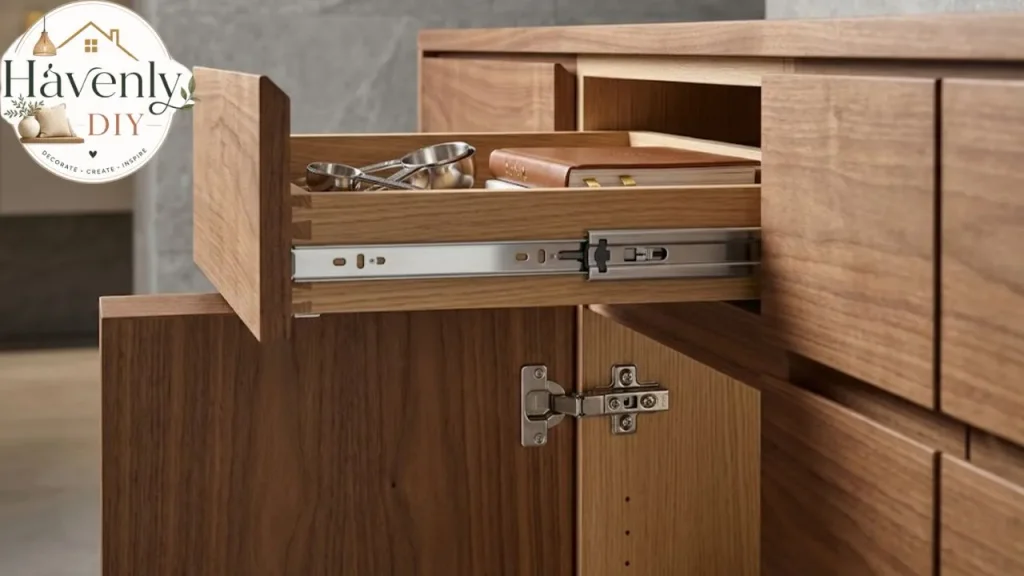
What is the cabinet box made from? What type of joinery is used? What are the drawer sides and bottoms made from? What hinges and drawer slides are included? Are the hinges adjustable? Is soft-close standard or an upgrade?
What does the warranty actually cover? How are replacement parts handled? Has the cabinetry undergone independent testing? For U.S. buyers, the KCMA A161.1 Quality Certification is one useful third-party signal. The program tests cabinet structure, doors, drawers, and finishes rather than simply evaluating appearance.
If your cabinetry contains regulated composite wood products in the U.S., also ask about TSCA Title VI compliance where applicable. EPA identifies hardwood plywood, MDF, and particleboard among the products covered by its formaldehyde-emission standards.
Certification isn’t the only measure of quality. But verifiable testing is much more useful than a salesperson saying, “These are premium cabinets.”
What should you spend your money on?
A useful way to divide a cabinet budget is by frequency of interaction. Spend first on the components you touch thousands of times. That usually means:
- drawer hardware
- hinges
- cabinet construction
- installation
- storage accessories you genuinely need
- finish durability
Then consider aesthetic upgrades. This isn’t a rule that says decorative details don’t matter. It is a reminder that cabinetry is both architecture and machinery. You live with the machinery every day.
Common modern cabinet mistakes
Choosing a trend instead of a room
A color can look incredible online and terrible in your particular light. Always examine physical samples in your kitchen.
Making everything handleless
Handleless cabinetry looks beautifully clean, but test the mechanism before committing. Convenience beats purity.
Using too many finishes
Modern kitchens generally benefit from a controlled palette. Three strong materials often look better than seven competing ones.
Ignoring the cabinet interior
A gorgeous exterior doesn’t compensate for frustrating storage. Open drawers and doors before you finalize the layout.
Buying cabinets before appliances
This can create expensive dimensional problems. Appliance specifications should be part of the cabinet planning process.
Treating installation as an afterthought
Modern cabinetry exposes mistakes. Uneven walls, inconsistent reveals, and crooked doors are much harder to hide behind ornate detailing.
Choosing based only on price per cabinet
Compare the complete specification. A cheaper cabinet with inferior hardware may not be cheaper after a few years of daily use.
The modern kitchen I would build today
If I were starting with a blank room and wanted a design that should age gracefully, I’d keep the cabinetry restrained. I’d choose simple full-overlay doors, warm natural wood or a soft neutral, durable hardware, and generous drawers.
I’d put serious thought into pantry storage. I’d use lighting to create atmosphere rather than trying to make the cabinetry do all the visual work. And I would resist the temptation to make every element “modern.”
The kitchen can have contemporary cabinets and traditional-looking stools. Modern cabinetry can sit beside an old timber floor. A sleek kitchen can have handmade tile. That contrast is often what keeps the room from feeling generic.
The bottom line
The best modern kitchen cabinets aren’t necessarily the ones with the most dramatic color, most expensive finish, or most futuristic hardware. They’re the ones that make the kitchen feel quieter, work harder, and suit the people using it.
Start with the room. Then your storage needs. Then cabinet construction. Then the door style. Then the finish and color.
Only after those decisions should you worry about the tiny details that make the photographs look perfect. Because the kitchen you live in every morning matters much more than the kitchen that looks impressive for ten minutes online.
What style of cabinets is most modern?
Slab or flat-panel doors with clean reveals, full-overlay construction, and restrained hardware are among the clearest modern choices. Frameless construction is also common, but frameless and full-overlay describe different things.
Are Shaker cabinets considered modern?
Yes. A simple, narrow Shaker door in a full-overlay configuration can look modern, particularly with contemporary hardware, lighting, and finishes.
Are wood cabinets modern in 2026?
Absolutely. Wood has become particularly prominent. Houzz reports that wood cabinetry was selected by 29% of renovating homeowners in its 2026 study, compared with 28% for white.
Are modern cabinets more expensive?
Not automatically. Slab doors can be relatively simple to manufacture, while costs rise with custom dimensions, premium finishes, specialized hardware, integrated appliances, and complex installation.
What is better: framed or frameless cabinets?
Neither is universally better. Frameless cabinetry offers a clean appearance and efficient interior access, while framed construction can provide different aesthetic and structural options. The quality of the box, hardware, and installation matters greatly.
Are matte cabinets better than glossy cabinets?
Matte finishes generally produce a softer, quieter appearance and can be a strong choice for modern kitchens. Gloss can reflect light and make some spaces feel brighter, but fingerprints and surface imperfections may be more noticeable.
What cabinet color will not look dated?
There is no guaranteed future-proof color. Natural wood, warm whites, and restrained neutral tones tend to provide flexibility because they can work with many countertop, flooring, and hardware choices.
What should I look for in high-quality cabinets?
Look at cabinet-box construction, joinery, hinges, drawer slides, finish durability, warranty terms, installation requirements, and independent certification where available.