

There’s a reason people linger longer around a round table. Nobody sits at the head. Everyone can see everyone else. Passing the salt doesn’t require a relay team.
A round table can also save a cramped dining area, soften a room full of straight lines, and squeeze one more chair in when friends drop by.
But choose the wrong size, base, or material,l and it becomes the piece everyone bumps into. This guide covers how to pick a round dining table that fits your room and your household: sizes and seating, clearance, base styles, materials, and how to style it once it’s home.
The Short Answer
For most homes, a 48-inch round table comfortably seats four people and can squeeze in a fifth or sixth. A 36- to 42-inch table suits two to four people in small spaces, while 54 to 60 inches seats five to eight.
Leave at least 36 inches between the table edge and the nearest wall or furniture so chairs can slide out, and 42 to 48 inches where people need to walk behind seated diners.
Choose a pedestal base if you want to fit more chairs without knocking knees on table legs. Pick a durable top, such as solid wood, sealed stone,ne or a good laminate, if the table will see daily family use.
Why Choose a Round Dining Table?
Better conversation. Everyone sits the same distance from the center, so no one gets stuck at the far end. It’s ideal for families and small gatherings.
Works in tight spaces. Without corners, a round table is easier to walk around, which helps in small dining rooms, kitchen nooks,oks and open-plan apartments.
Flexible seating. It’s easier to add an extra chair at a round table than at a rectangular one, where corners and legs get in the way.
Softens a room. Most furniture is rectangular. A circle breaks up all those lines and makes a space feel more relaxed.
Safer for small children. No sharp corners at head height for toddlers running past.
The trade-off is that very large round tables become awkward. Past about 72 inches, the center is hard to reach, and people sit far apart. For big groups, an oval or rectangular table often works better.

Round vs Square vs Oval vs Rectangular
If you’re torn between shapes, it helps to compare them side by side.
| Shape | Best for | Strengths | Weaknesses |
|---|---|---|---|
| Round | 2–6 people, small or square rooms | Easy conversation, no corners, flexible seating | Hard to reach the center on large sizes |
| Square | 2–4 people, square rooms | Clean look, pairs well with corners | Awkward for 5–6 people |
| Oval | 6–10 people, longer rooms | Seats more, still softens the room | Needs a longer space |
| Rectangular | 6+ people, long rooms | Seats the most, fits long rooms | Corners, people at the ends feel distant |
A round dining table is the strongest choice for four to six people in a square or compact room. If you regularly seat eight or more, an oval gives you the same soft shape with more space along the sides.
Round Dining Table Sizes and Seating
These sizes are common across manufacturers, though seating depends on chair width and how cozy your guests don’t mind being.
| Table diameter | Comfortable seating | Squeezed seating | Best for |
|---|---|---|---|
| 30–36 inches | 2 | 3 | Breakfast nooks, bistro corners, couples |
| 40–44 inches | 4 | 4 | Small dining areas, apartments |
| 48 inches | 4 | 5–6 | Most small-to-medium dining rooms |
| 54 inches | 5–6 | 6 | Families who host occasionally |
| 60 inches | 6 | 8 | Medium to large dining rooms |
| 72 inches | 8 | 9–10 | Large rooms and frequent entertaining |
A helpful rule of thumb is to allow about 24 inches of edge for each diner. You can work out the edge length by multiplying the diameter by 3.14 (pi) and dividing by 24.
For example, a 48-inch table has an edge of about 150 inches, which gives just over six 24-inch places. In practice, chair width and legs usually make four or five more comfortable.
Armchairs need more space than armless side chairs. If you love chairs with arms, size up or plan for fewer seats.
How to Measure Your Space
Getting the size right is mostly about clearance, the space around the table.
Minimum clearance. Leave at least 36 inches from the table edge to walls or furniture. That gives room to pull out a chair and sit down.
Walkway clearance. If people need to walk behind seated diners, aim for 42 to 48 inches.
Quick formula. Add your preferred clearance on both sides to the table diameter. For a 48-inch table with 36 inches of clearance on each side, you need a space at least 120 inches (10 feet) across.
| Table diameter | Minimum room width (36″ clearance) | Comfortable room width (42″ clearance) |
|---|---|---|
| 36 inches | 9 feet | 10 feet |
| 48 inches | 10 feet | 11 feet |
| 54 inches | 10.5 feet | 11.5 feet |
| 60 inches | 11 feet | 12 feet |
Test it before you buy. Cut a circle from cardboard or mark the outline on the floor with painter’s tape. Place your chairs around it and walk through the space for a day or two. It’s the simplest way to avoid a costly mistake.
Watch for doors, cabinet drawers, and appliance doors that open toward the table. These need clearance too.
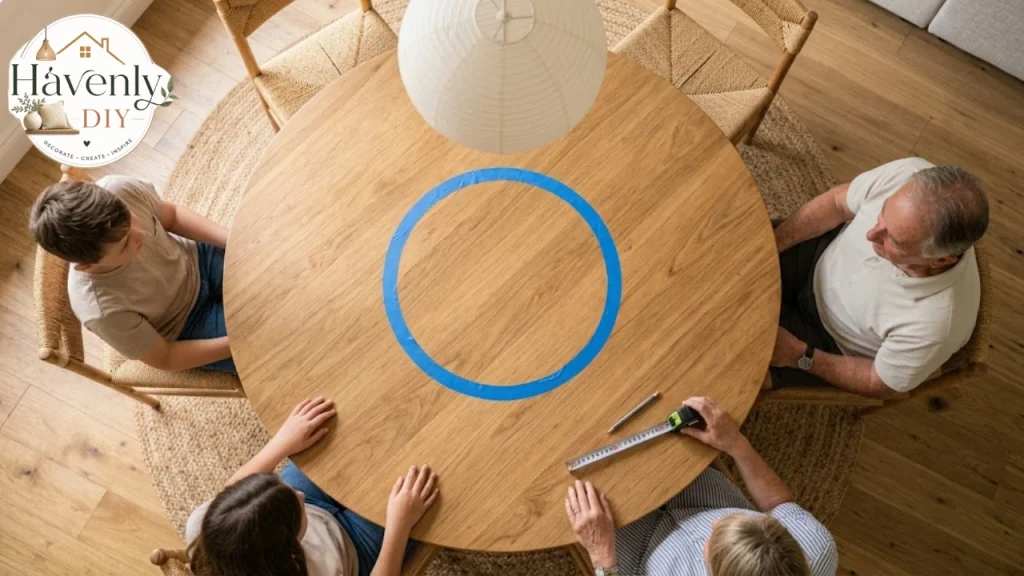
Table Height and Chair Fit
Standard dining tables are usually about 28 to 30 inches tall.
Most dining chairs have a seat height around 18 inches, leaving roughly 10 to 12 inches between the seat and the underside of the table. That gap lets you sit comfortably without your knees hitting the apron, the frame just under the tabletop.
Counter-height round tables stand around 34 to 36 inches tall and pair with counter stools. Bar-height tables reach about 40 to 42 inches. Both are popular for kitchens and casual spaces but can be harder for small children and older adults.
If your table has a deep apron, check the clearance between the apron and chair seat before buying.
Pedestal vs Legs: Choosing the Base
The base affects how many people fit and how comfortable they are.
Pedestal Base
A single central pedestal keeps legs out of the way, so you can fit chairs anywhere around the edge. It’s the most flexible option for a round dining table, especially in smaller sizes.
The trade-off is stability. Large tops on a narrow pedestal can wobble or tip when someone leans on the edge. Look for a wide, heavy base or a split pedestal with feet that spread out.
Four Legs
Traditional four-leg tables are very stable but can restrict seating. Legs often end up between diners’ knees, especially on smaller tables.
They work well when you’ll seat exactly four people, one between each pair of legs.
Tripod and Splayed Legs
Three legs angled outward, common in mid-century and Scandinavian designs, give stability with fewer obstructions than four straight legs.
Trestle and Sculptural Bases
Crossed, X-shaped, or sculptural bases make a strong design statement. Check that the base leaves room for feet and chair legs before you fall in love.
Materials Compared
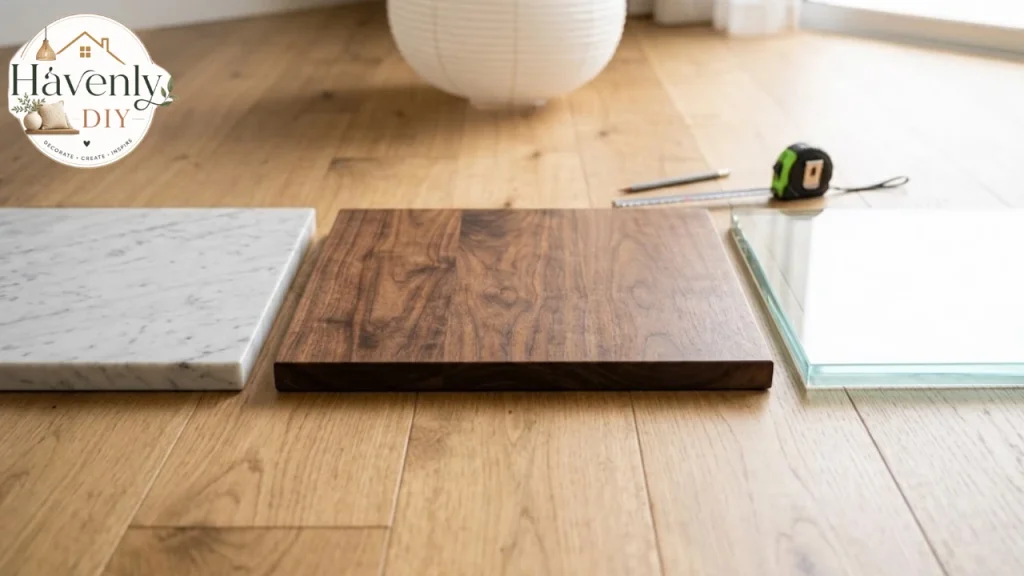
The tabletop material affects durability, maintenance, and the overall feel.
| Material | Look | Pros | Cons |
|---|---|---|---|
| Solid wood | Warm, classic | Durable, can be refinished | Can scratch, reacts to humidity |
| Wood veneer | Wood look, lighter | Affordable, stable | Can’t be sanded much, chips at edges |
| Marble | Elegant, luxurious | Beautiful, cool to touch | Etches with acids, stains, very heavy |
| Engineered stone / quartz | Clean, modern | Tough, low maintenance | Heavy, can be costly |
| Glass | Light, airy | Makes small rooms feel bigger | Shows fingerprints, can chip |
| Laminate | Varied | Budget-friendly, easy to clean | Less premium feel, hard to repair |
| Metal | Industrial, sleek | Strong, good outdoors | Can feel cold, may dent or scratch |
For families with young children, solid wood or a tough laminate is forgiving. Marble and glass need more care.
For small spaces, glass tops or slim pedestal bases help the room feel open.
For a showpiece, marble or a beautifully grained wood makes the table the room’s focal point.
Extendable Round Tables
If you usually seat four but sometimes host eight, an extendable table can be the best of both worlds.
Many round tables extend into an oval with one or two leaves. Some have butterfly leaves that fold and store inside the table, which saves you finding a closet for them.
When shopping, check how easy the mechanism is to use, where the leaves are stored, and whether the base stays stable when extended. Pedestal tables with a split base handle extensions especially well.
Drop-leaf round tables are another option for very small homes. The sides fold down against the base when not in use, turning a dining table into a slim console.
Round Dining Table Styles
The table’s style should match the rest of your space. Here’s how the main looks translate.
Modern. Clean lines, a white, black or stone top, and a sleek pedestal or metal base. Pairs with minimal chairs and simple lighting.
Farmhouse. Chunky wood, a turned pedestal, distressed or natural finish. Pair with Windsor or cross-back chairs.
Mid-century. Tapered or tripod legs, warm walnut or teak, and molded or bentwood chairs.
Scandinavian and Japandi. Light oak or ash, simple forms, and woven or wooden chairs. Quiet and natural.
Traditional. Rich wood, carved pedestal, upholstered or carved chairs, and a classic chandelier.
Coastal. Whitewashed or light wood, rattan or wicker chairs, and natural fiber accents.
Industrial. Metal base with a reclaimed wood or concrete top, plus metal or leather chairs.
Not sure which direction suits you? Our interior design style quiz can help, and our guide to modern eclectic interior design shows how to mix pieces from different styles.
Choosing Chairs for a Round Table
Chairs make or break a round dining table setup.
Count your space, not just your guests. Measure the chair width at its widest point. Armless chairs about 17 to 20 inches wide fit best around round tables.
Leave elbow room. Aim for at least 6 inches between chairs so people aren’t bumping elbows.
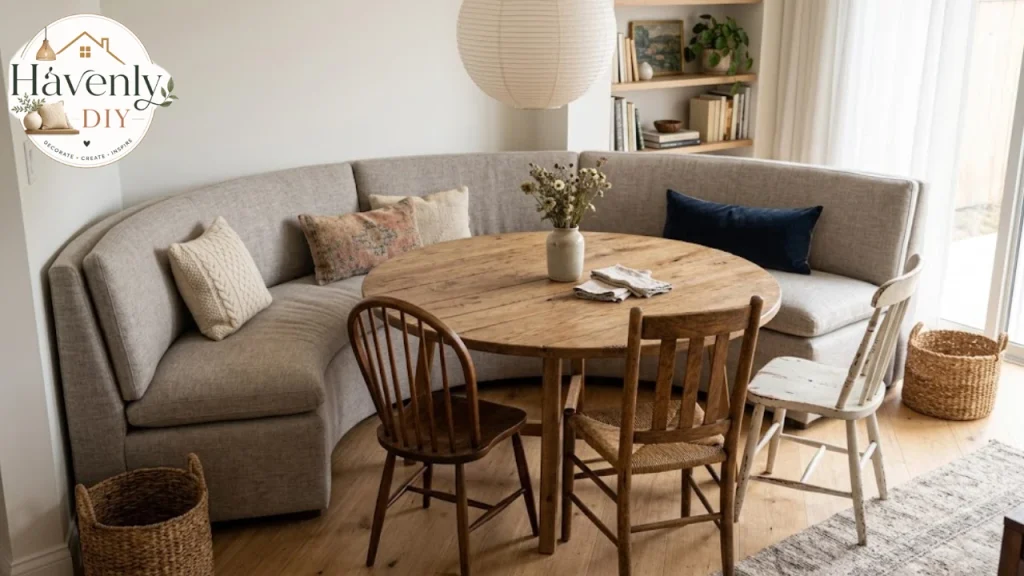
Consider a bench. Curved benches are made for some round tables and can seat more people, especially children, in less space.
Mix and match carefully. Mixed chairs can look charming, but keep one element consistent, such as color, material or height.
Check seat height. Make sure chairs leave 10 to 12 inches between seat and tabletop.
Styling Your Round Dining Table
The Right Rug
A rug defines the dining zone and softens noise. Choose one large enough that chairs stay on it when pulled out.
A simple rule: add about 24 inches on every side of the table, so the rug diameter or width is the table diameter plus 48 inches. A 48-inch table needs a rug of about 8 feet.
Round rugs echo the table’s shape beautifully, but square rugs work too. Low-pile, flat-weave and indoor-outdoor rugs are easier to clean under a dining table.
Lighting
A pendant or chandelier centered over a round dining table anchors the space.
Hang it so the bottom sits about 30 to 36 inches above the tabletop in a room with standard ceiling height. Choose a fixture roughly half to two-thirds the width of the table, so it feels balanced without overwhelming the room.
A dimmer lets you switch from bright everyday light to softer light for dinners.
Centerpieces
Keep centerpieces low enough that people can see each other across the table. A single vase, a low bowl of fruit, or a few candles works better than a tall arrangement.
On a small table, use a lazy Susan in the center so shared dishes are easy to reach.
Round Tables in Small Apartments
In a studio or small apartment, the dining table often doubles as a desk, a prep counter, and a place to drop the mail. A round table handles that juggling act well.
Choose a 36- to 42-inch pedestal table so two to four people can sit without legs in the way. Pair it with stackable or folding chairs that can move elsewhere when you need floor space.
Place the table near a window or in a corner with a built-in bench, sometimes called a banquette, to save even more room. A curved or L-shaped bench tucks neatly around a round tabletop and adds hidden storage underneath.
If the table also serves as a workspace, choose a durable, wipe-clean surface and good overhead lighting. A small lamp or plug-in wall sconce nearby helps on dark evenings without adding floor clutter.
In very tight spaces, a wall-mounted drop-leaf table is the ultimate space saver. Folded down, it takes almost no room; folded up, it seats two.
Choosing a round dining table for a small home is really about flexibility: one piece that adapts to meals, work, and guests as your day changes.
Where a Round Table Works Best
Small dining rooms. The lack of corners makes it easier to move around.
Breakfast nooks and kitchens. A small round table slots neatly into a corner or bay window. If you’re redesigning the kitchen too, our guides to the coastal kitchen and modern kitchen cabinets show how to tie the eating area to the rest of the room.
Square rooms. A round table centered in a square room creates even walkways on every side.
Open-plan spaces. A round table defines the dining zone without the heavy visual block of a long rectangle.
Under a statement light. A circle and a pendant above it create a natural focal point.
For warm, earthy dining spaces, terracotta and wood pair beautifully with a round wood table, an approach common in Spanish-style homes.
Round Tables for Families With Kids
A round table is often the friendliest shape for family life, but a few choices make it even easier.
Pick a forgiving finish. Solid wood with a durable sealed finish hides small dents and can be refinished later. Matte laminate and engineered stone shrug off crayons and juice.
Check stability. Children lean, climb and tug on edges. Choose a pedestal with a wide base or a sturdy four-leg design, and avoid lightweight tops on narrow stems.
Round off the edges. A soft, rounded edge profile is kinder to small heads and elbows than a sharp, squared edge.
Plan for high chairs and boosters. Leave a gap in the chair circle for a high chair, and check that its tray clears the tabletop.
Use washable seating. Wipe-clean chairs or removable, washable seat cushions save a lot of scrubbing.
For busy households, a round dining table also keeps everyone in view, which makes it easier to help with homework or notice who hasn’t finished their vegetables.
Where to Save and Where to Splurge
You don’t need to spend the most on every part of your dining setup.
Splurge on the tabletop and base. These take the most wear and are the hardest to upgrade later. A solid, stable table can last decades.
Save on chairs if needed. Chairs are easier to replace or reupholster as tastes change. Many people buy a good table first and upgrade chairs over time.
Save on decor. Rugs, centerpieces,s and placemats are easy to change seasonally.
Consider secondhand. Solid wood round tables are common on the vintage market and can often be refinished for far less than buying new. Check for wobble, water damage, and loose joints before buying.
If you’re furnishing the whole room at once, our roundup of the best home furnishings can help you balance quality and budget across pieces.
Caring for Your Table
Wood. Wipe spills quickly, use coasters and placemats, and avoid harsh cleaners. Keep it away from direct heat and strong sun to reduce cracking and fading.
Marble and stone. Clean with a mild, pH-neutral cleaner and reseal natural stone as the manufacturer recommends. Wipe up acidic spills such as lemon juice and wine immediately.
Glass. Use glass cleaner and a microfiber cloth. Felt pads under decorative pieces help prevent scratches.
Pedestal tables. Check and tighten base bolts occasionally, especially if the table starts to wobble.
For easier home routines, browse our home cleaning guides.
Common Mistakes When Buying a Round Dining Table
Buying too big. A table that fits the room but leaves no clearance makes every meal awkward.
Ignoring the base. Four legs on a small table can make four chairs impossible to fit comfortably.
Forgetting the chairs. Chunky armchairs can turn a six-seat table into a four-seat one.
Choosing a delicate top for heavy use. Marble and glass look stunning but need care around young children.
Skipping the floor test. A few minutes with painter’s tape can save you a return and a delivery fee.
FAQs:
What size round table seats 4?
A 40- to 48-inch round table seats four comfortably. A 48-inch table gives more elbow room and can squeeze in a fifth chair.
What size round table seats 6?
A 54- to 60-inch round table seats six comfortably. A 60-inch table can fit up to eight with slim chairs.
What size round table seats 8?
A 72-inch round table seats eight comfortably. At that size, an extendable table or a lazy Susan helps people reach shared dishes.
Are round tables better for small spaces?
Often, yes. With no corners, they’re easier to walk around and can fit more people in less floor space than a square table of similar size.
What rug size do I need under a round table?
Add about 48 inches to the table diameter. A 48-inch table needs a rug about 8 feet across so chairs stay on the rug when pulled out.
Pedestal or legs: which is better?
A pedestal base fits more chairs and avoids knocked knees. Four legs are very stable but can limit seating, especially on smaller tables.